How GPAConverter works

Your Academic Journey: From Baseline to Final Plan

Select your current goal below to explore how our interactive tools guide your study path.

Establish Your Academic Baseline

Estimate or convert your current academic standing across multiple grading scales before applying to universities or jobs.

Try a Realistic Example CGPA breakdown

Change any grade or credit value and watch the CGPA update.

Sample courses with grade and credits
CourseGradeCredits
Course A
Course B
Course C
Course D
Total credits12
Calculated CGPA3.56 / 4.00
Calculate Your Full CGPA

Determine What You Need Next

Don’t guess your target scores. Determine what score you need on your final exam to reach a target course grade.

Try a Realistic Example Required final score

Drag the sliders to test different targets.

Remaining final exam weight: 40%

Required final exam score95.5%
FeasibilityChallenging but possible!
Calculate Your Target Final Score

Turn Requirements into a Practical Plan

Stay on top of mandatory attendance thresholds and allocate weekly study blocks to reach academic success without burnout.

Try a Realistic Example Attendance safety margin

Change the numbers to match your own class.

Current attendance: 85%

Safety statusSafe
Classes you can safely miss5 classes

Counts upcoming classes, assuming you attend none of them. Your institution’s own rules always apply.

Check Your Attendance Safety Margin
  • Free, no sign-up
  • Instant results
  • Nothing leaves your device
Student tools

Make every academic decision clearer.

Calculate grades, understand your GPA, and plan your next step with confidence.

Calculators & Converters

Quick tools to convert scores, calculate your GPA, and understand your results.

Grade & Study Tools

Plan better, track your progress, and stay on top of your academic goals.

Final grade

Final Grade Calculator

Find the exact score you need on your final exam to reach your target grade, using one weight or your full syllabus.

Simple & full-course modes Open tool : Final Grade Calculator
Study planner

Study Schedule Planner

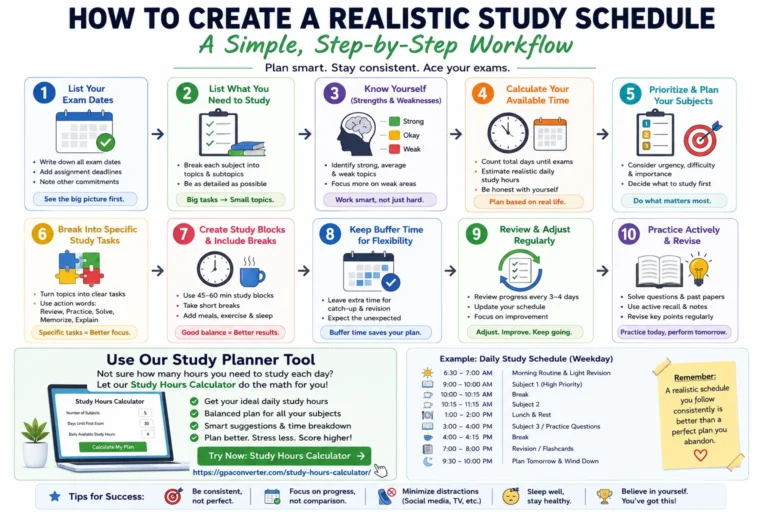
Turn your exam date, study days, and topics into a day-by-day plan with practice, review, and a readiness estimate.

Weak topics prioritized Open tool : Study Schedule Planner
Disclaimer

Important Disclaimer & Limitations: What GPAConverter Tools Do Not Do

GPAConverter calculators are built to help you understand your results and plan ahead. They are not a substitute for official records or professional advice. Please read the points below before relying on any result.

01 Estimates

These tools provide mathematical estimates, not official transcript evaluations.

Our grade and GPA calculators apply mathematical formulas to the credit values, grades, and scales you enter. However, a converted GPA or percentage is an estimate, and official equivalencies vary by institution. For formal credential evaluation required for university admissions or visa processing, always consult a recognized evaluation body such as WES (World Education Services) or your university's registrar.

Best next step: ask a recognized evaluation body or your registrar for an official evaluation.

02 Not advice

We are calculators, not academic advisors.

Our calculators can help you work out required attendance thresholds, target exam scores, or a projected CGPA. They cannot decide whether you should drop a course or how a single grade affects your overall degree standing. For strategic academic decisions, speak with your professors or your institution's academic advisors.

Best next step: speak with your professors or academic advisors before making big decisions.

03 Policies vary

Institutional grading policies and curves vary.

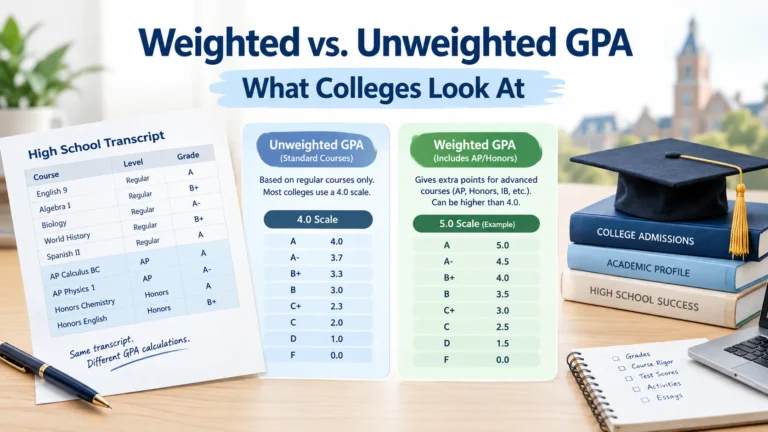
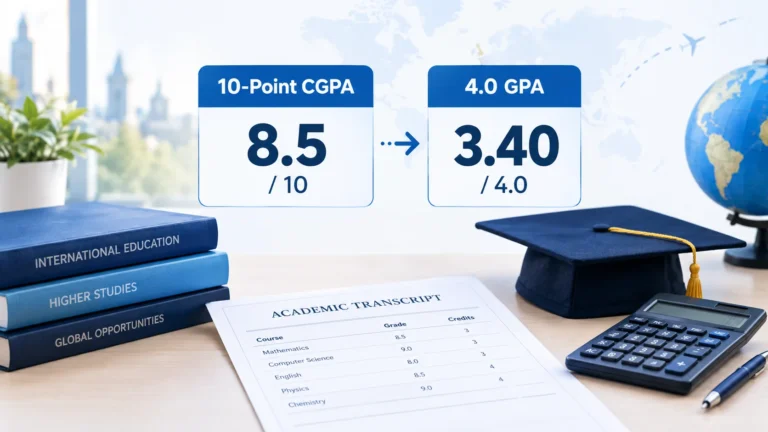
Academic policies differ widely across schools. Some institutions replace dropped course grades, apply custom curves, or use their own weighting rules. Our tools support several common scales, including 4.0, 4.3, 5.0, 10.0, and percentage, and some also offer a custom option. Always check your final numbers against your school's official grading handbook.

Best next step: compare your result with your school's official grading handbook.

Every calculator on GPAConverter shows the formula behind its result, so you can see exactly how a number was reached. Questions about a result? Contact us.

From the blog

Study tips, guides & updates

Fresh reads on grades, GPA, and getting the most out of your study time.

Quick answers

Frequently Asked Questions

Straight answers about how the calculators work, what the results mean, and where an estimate ends and an official evaluation begins.

Can't find your answer?

Send us a message and we will point you to the right tool or explanation.

Contact us
What is GPAConverter and what can I use it for?

GPAConverter is a free set of six calculators built for students. You can calculate a grade from exam marks, work out a credit-weighted CGPA, find the score you need on a final exam, convert GPA to percentage and back, plan study hours before an exam, and check your attendance against a required percentage. Each calculator shows the formula behind its result, so you can see how the number was reached.

Are the calculators free, and is my data stored?

All six calculators are free, and you do not need an account or sign-up to use them. The numbers you enter are processed in your browser and are not saved to our servers. Like most websites, we may use basic analytics and cookies to understand how the site is used, and our Privacy Policy explains how.

What is the difference between GPA and CGPA?

GPA usually summarizes your grades for a single term, while CGPA (cumulative GPA) combines grades and credit hours from several terms into one running average. In your first term the two numbers are the same. After that, CGPA moves more slowly because it also includes your earlier results. Some institutions use other labels such as SGPA, so check how your own school defines each term.

How is CGPA calculated?

CGPA is credit weighted. Each subject's grade point is multiplied by its credit hours, those weighted points are added together, and the total is divided by the total credit hours. A 4-credit course therefore counts for more than a 1-credit course, even when the grades are identical. The Multi-Subject CGPA Calculator does these steps for you, and can also combine a previous CGPA with your latest semester.

How does GPA to percentage conversion work, and is the result official?

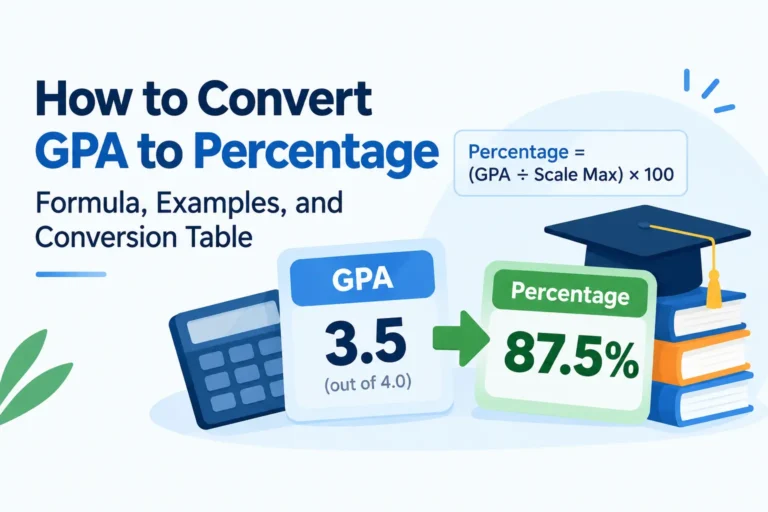
The GPA to Percentage Converter uses a proportional formula:

Percentage = (GPA Ă· Scale Max) Ă— 100

For example, a 3.2 GPA on a 4.0 scale gives 80%. This is a mathematical estimate. Many institutions publish their own conversion tables or rules, and credential evaluators may use different methods, so the result may not match an official equivalency. When the number is needed for an application, use the method your institution or the receiving organization asks for.

Which grading scales are supported?

The GPA to Percentage Converter supports ten scales: 4.0, 4.3, 4.5, 5.0, 6.0, 7.0, 9.0, 10.0, 12.0, and 20.0. The Multi-Subject CGPA Calculator offers 4.0, 4.3, 5.0, and 10.0 presets, plus a custom option where you enter your own grade points. A supported scale does not mean every school in a country uses it, so confirm your institution's scale before you calculate.

Can I use these results for admissions, scholarships, or visa applications?

Treat them as planning estimates rather than official records. Admissions offices, scholarship committees, and immigration authorities usually rely on official transcripts and their own evaluation rules. The calculators can help you understand where you stand, but you should always confirm the required format and method with the organization asking for the information.

How do I find out what score I need on my final exam?

Enter your current grade, the weight of the final exam, and the overall grade you want into the Final Grade Calculator. It works backward to the score you need, and tells you when the target is already secured or out of reach. If your course has several weighted parts, such as assignments, quizzes, and a project, the full course mode lets you add each one.

How many classes can I miss and still meet my attendance requirement?

Enter the classes you have attended and the classes held so far in the Attendance Percentage Calculator, then pick your required percentage, from 50% to 95% or a custom value. It shows how many more classes you can miss, or how many you need to attend to recover, and the what-if option lets you test future scenarios. Requirements differ between institutions, so check your own attendance policy.

What does the readiness score in the Study Hours Calculator mean?

The readiness score in the Study Hours Calculator compares the learning time in your plan with a recommended baseline for the topics you entered. It is a planning indicator, not a prediction of your exam result. A lower score usually means your available time is short compared with your topic list, which is useful to know early, while there is still time to adjust the plan.

Why is my result different from what my school shows?

Schools differ in grading scales, rounding rules, how repeated courses are treated, and how credits are weighted. A calculator applies a standard formula to the numbers you enter, so differences are possible. Check that you selected the right scale, entered the correct credits and grades, and compare the result with your institution's published method.

About GPAConverter

Practical academic tools, built for students.

GPAConverter was created to provide free, practical tools that help students calculate and understand GPA, CGPA, grades, attendance, final grades, and study planning.

The site combines interactive calculators with explanations and examples so students can understand not only the number produced by a calculation, but also what that result means and when a conversion may only be a mathematical estimate rather than an official academic equivalency.

  1. Free to use

    Academic tools designed for students.

  2. Clear calculations

    Results are presented with understandable calculations and explanations.

  3. Transparent about limitations

    Mathematical estimates are distinguished from official academic evaluations.