Two students apply to the same college. Both have a 3.8 GPA, but one took mostly standard classes while the other challenged themselves with AP, honors, or other advanced courses. Do their GPAs tell the whole story? Not quite.
This is where weighted vs. unweighted GPA comes in. One measures your grades without giving extra points for advanced classes, while the other may reward you for taking more challenging courses. Both can help colleges understand your academic record, but neither tells the full story on its own.
If you’re in high school, understanding the difference can help you choose courses, interpret your transcript, and prepare for college applications. Let’s look at how each GPA works, how to calculate it, and what admissions officers may consider when reviewing your grades.
Weighted GPA vs Unweighted GPA: An Example
Suppose two students attend the same high school. The school calculates unweighted GPA on a 4.0 scale and also uses a separate weighted GPA system that adds 1.0 point to eligible AP courses.
| Student A | Student B | |
| Unweighted GPA | 3.80 | 3.80 |
| Advanced courses | 1 AP course | 4 AP courses |
| Weighted GPA | Depends on grades and school rules | Depends on grades and school rules |
Both students have the same unweighted GPA because their grades are calculated without advanced-course bonus points. Their weighted GPAs may differ because the school gives additional points for eligible AP courses.
This illustrates why GPA alone may not show the full context of a student’s transcript.
What Is Unweighted GPA?
An unweighted GPA measures your academic performance without adding extra points for taking advanced classes. Whether you earn an A in a standard course or an A in an AP or honors course, usually you will receive the same grade-point value.
Many high schools use a 4.0 unweighted GPA scale, where an A is typically worth 4.0, a B is worth 3.0, a C is worth 2.0, and a D is worth 1.0. Exact grade-point values can vary by school.
For example, if you earn an A in English, a B in mathematics, and an A in history, your unweighted GPA is calculated from those grades without considering whether the courses were standard or advanced.
An unweighted GPA gives you a straightforward view of your grades. However, it doesn’t show the level of difficulty of the courses you completed.
Benefits of Unweighted GPA
- Clear view of grades: It shows grade performance without additional points for advanced coursework.
- Simpler comparisons within a shared scale: Students can compare results more easily when their schools use the same grading rules.
- Less affected by weighting policies: The GPA doesn’t rise simply because a course receives extra points.
- Useful for tracking performance: It can help you see how your grades are changing over time.
Factors Affecting Unweighted GPA
An unweighted GPA is not influenced by course-level bonuses, but it can still be affected by the way your school records and calculates grades.
Common factor that affect unweighted GPA include:
- Final course grades: The grades you earn in each class form the basis of your GPA.
- Plus and minus grading: A school may assign different points to an A−, A, or A+.
- Course credits: Some schools give more weight to courses with higher credit values, even when they don’t add advanced-course bonuses.
- Repeated courses: Your school’s rules may determine whether the original grade, replacement grade, or both are included.
- Pass/fail courses: Certain courses may be excluded from GPA calculations, depending on school policy.
- Rounding rules: Your school may round GPA values to a specific number of decimal places.
For an accurate unweighted GPA, use the grade-point values and calculation rules on your official transcript or in your school’s academic handbook.
How to Calculate Unweighted GPA
To calculate an unweighted GPA, convert each course grade into grade points using your school’s unweighted grading scale. Add those grade points and divide by the number of courses, assuming each course has equal weight.
Unweighted GPA = Total grade points ÷ Number of courses
For example, suppose you earned:
- English: A = 4.0
- Mathematics: B = 3.0
- Science: A = 4.0
- History: B = 3.0
Your total grade points for four courses is 14.0.
Unweighted GPA = 14.0 ÷ 4 = 3.50
Your unweighted GPA is 3.50 on this example scale. If your school uses plus/minus grades, different grade-point values, or credit weighting, use its official calculation method instead.
What Is a Weighted GPA?
A weighted GPA takes course difficulty into account by assigning additional grade points to certain advanced classes. Depending on your school’s policy, courses such as AP, IB, honors, or dual-enrollment classes may receive extra weight.
For example, a school might award 4.0 points for an “A” in a standard course and 5.0 points for an “A” in an AP course. Under that system, a student taking more advanced classes may earn a weighted GPA higher than 4.0.
Weighted GPA scales are not the same at every school. Some use a 4.5 scale, others use a 5.0 scale, and some have their own weighting rules. The extra points awarded for advanced coursework also vary.
Weighted GPA reflects a school’s designated course-weighting policy rather than measuring course difficulty directly. Two courses labelled as advanced may have different academic demands, and schools may award them different weighting bonuses.
Benefits of Weighted GPA
- Recognizes advanced coursework: It can show that you’ve taken AP, IB, honors, or other weighted courses.
- Adds context to grades: It may help distinguish between course loads when students take different levels of classes.
- Can reflect academic challenge: It gives schools that use weighting a way to include course rigor in the GPA calculation.
- May help with school-based comparisons: Within the same high school and weighting system, it can help describe how students performed across weighted courses.
Factors Affecting Weighted GPA
Your weighted GPA can be affected by several parts of your school’s grading policy and your academic record, including:
- Course level: Whether a class is standard, honors, AP, IB, dual-enrollment, or another category your school weights.
- Grades earned: Your final grade in each course determines the starting grade-point value.
- Bonus-point rules: The extra points assigned to weighted courses can vary.
- Credit values: Some schools account for course credits or different course lengths when calculating GPA.
- Weighting limits: Certain schools cap the extra points or limit which courses qualify for weighting.
- Retakes and repeated courses: Your school’s policy determines how repeated classes affect the GPA.
Since these rules differ, two students with similar grades and course loads may have different weighted GPAs if their schools calculate them differently.
How to Calculate Weighted GPA
To calculate a weighted GPA, you should first convert each grade into grade points. Then apply any additional points your school assigns to weighted courses, such as AP or honors classes. Finally, average the adjusted points according to your school’s rules.
For a simple example, suppose a school uses a 4.0 scale for standard courses and adds 1.0 point for AP courses. You earn:
- Standard English: A = 4.0
- AP Mathematics: B = 4.0 (3.0 + 1.0)
- Standard Science: A = 4.0
- AP History: A = 5.0 (4.0 + 1.0)
Total weighted grade points = 17.0
Weighted GPA = 17.0 ÷ 4 = 4.25
Your weighted GPA is 4.25 under this example policy. Schools may award different bonuses, use course credits, or cap weighted grade points, so check your school’s grading rules before calculating your own result.
Weighted vs Unweighted GPA: Key Differences
The main difference is how each system treats course difficulty.
- Unweighted GPA measures your grades using the same grade-point scale, regardless of course level.
- Weighted GPA may add extra grade points for advanced or more challenging courses.
Here’s a simple comparison:
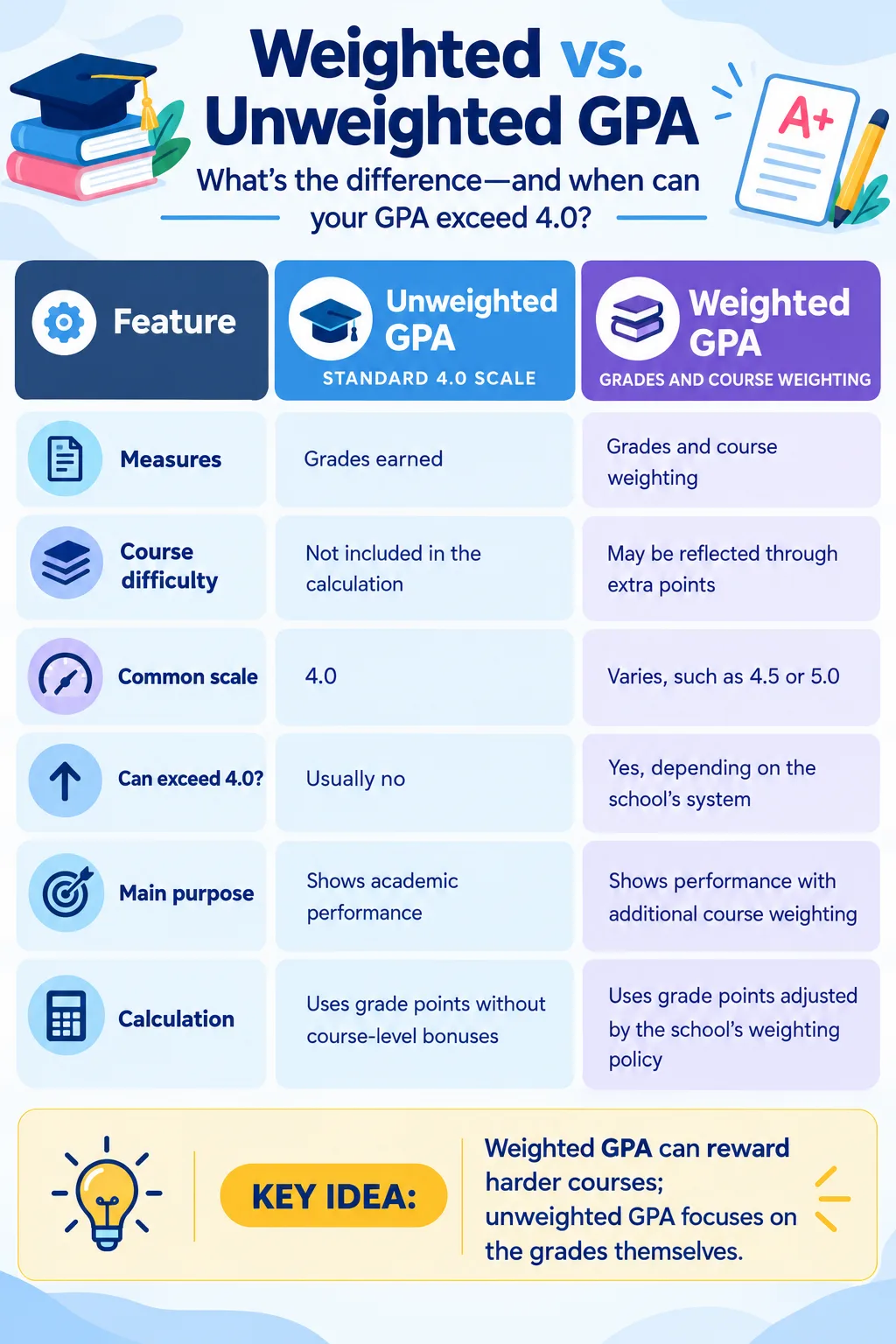
Neither system is a complete measure of your academic ability. Your transcript also shows which courses you took, how your grades changed over time, and the academic opportunities available at your school.
Weighted vs. Unweighted GPA Scale
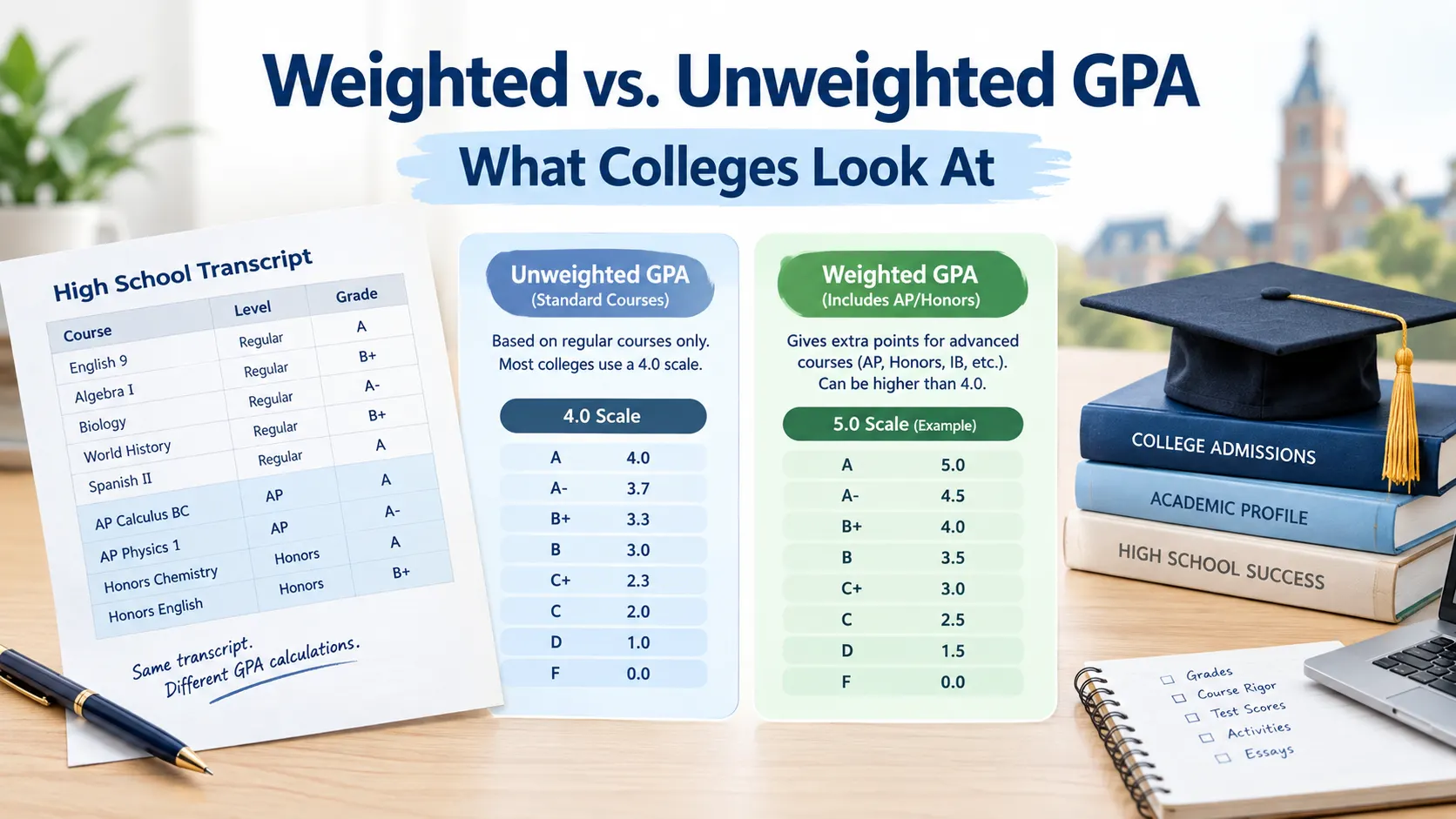
The main difference between weighted and unweighted GPA scales is how they treat challenging courses. An unweighted scale assigns grade points based on your grades alone, while a weighted scale may add extra points for courses such as AP, IB, or honors classes.
Here’s an illustrative comparison using a typical 4.0 unweighted scale and a weighted scale that adds 1.0 point for AP courses.
| Letter Grade | Unweighted GPA | Weighted GPA (Standard Course) | Weighted GPA (AP Course) |
| A | 4.0 | 4.0 | 5.0 |
| B | 3.0 | 3.0 | 4.0 |
| C | 2.0 | 2.0 | 3.0 |
| D | 1.0 | 1.0 | 2.0 |
| F | 0.0 | 0.0 | 0.0 |
For this illustration, the school adds 1.0 point to AP grades of D or higher but does not award bonus points for an F. Other schools may apply different weighting rules.
Example: How the Two Scales Can Differ
Imagine you earn an “A” in a standard course and a “B” in an AP course. On the unweighted scale, those grades are worth 4.0 and 3.0, giving you an average GPA of 3.50.
On the weighted scale, the “A” in the standard course is worth 4.0, while the “B” in the AP course receives 4.0 points after the AP bonus. Your weighted GPA for those two courses is 4.00.
The higher weighted GPA reflects the school’s additional points for advanced coursework. It doesn’t mean your letter grades changed. Since weighting policies vary between high schools, check your school’s grading rules to understand which scale appears on your transcript.
Can Weighted and Unweighted GPA Be Compared With Percentages?
GPA and percentage both describe your academic performance, but they measure it differently. A percentage shows the marks you earned, while GPA converts your grades into grade points. A weighted GPA may also include extra points for advanced courses, so it cannot always be converted directly into a percentage.
Example: GPA and Percentage Compared
Suppose two students earn the same grades in courses with the same marks, but one takes an AP course. Their percentages may be the same, while their weighted GPAs may differ if their school awards extra points for advanced classes.
| Measure | Student A (Standard Courses) | Student B (Includes AP Course) |
| Average percentage | 90% | 90% |
| Unweighted GPA (illustrative 4.0 scale) | 4.0 | 4.0 |
| Weighted GPA (illustrative scale) | 4.0 | 5.0 |
This example assumes the students earn an “A” in every course and the school adds “1.0” point for an “A” in an AP course. Actual weighting rules vary by school.
Can You Convert GPA to a Percentage?
You can use a simple proportional calculation to estimate a percentage from an unweighted GPA when the maximum scale is known:
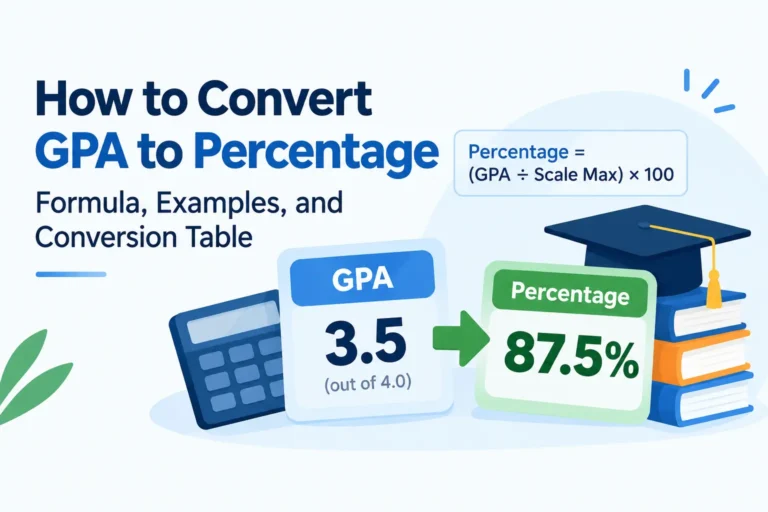
Percentage estimate = (GPA ÷ Maximum GPA) × 100
| GPA | Scale | Simple Percentage Estimate |
| 4.0 | 4.0 | 100% |
| 3.8 | 4.0 | 95% |
| 3.6 | 4.0 | 90% |
| 3.2 | 4.0 | 80% |
| 3.0 | 4.0 | 75% |
These are mathematical estimates, not official conversions. Schools may use specific grade boundaries or conversion rules, and a weighted GPA includes additional course points that do not necessarily represent higher exam marks.
If you want to estimate a percentage from your GPA, try our tool GPA to Percentage Converter. It can help you calculate a proportional estimate based on your GPA and grading scale. For college applications or official records, use the percentage on your transcript or follow the institution’s conversion instructions.
Weighted GPA vs. Unweighted GPA: High School Examples
Imagine two students who take different course loads at the same high school. For this example, the school uses a 4.0 unweighted scale and and a separate weighted GPA system that adds 1.0 extra point for an “A” in an AP course.
| Course | Student A | Student B |
| English | A (standard) | A (AP) |
| Mathematics | A (standard) | B (AP) |
| Science | B (standard) | A (standard) |
| History | A (standard) | B (standard) |
Using a simple 4.0 scale, Student A earns grade points of 4.0, 4.0, 3.0, and 4.0. This gives Student A an unweighted GPA of 3.75.
Student B earns unweighted grade points of 4.0, 3.0, 4.0, and 3.0 for the four courses. The calculation is (4.0 + 3.0 + 4.0 + 3.0) ÷ 4 = 3.50. Therefore, Student B‘s unweighted GPA is 3.50.
For the weighted GPA, the school adds 1.0 extra point to eligible AP courses. Student B therefore receives 5.0 points for the AP English “A” (4.0 + 1.0) and 4.0 points for the AP Mathematics “B” (3.0 + 1.0). Their weighted grade points are 5.0, 4.0, 4.0, and 3.0, resulting in a weighted GPA of 4.00.
This example shows how a weighted GPA can account for advanced coursework in addition to the grades earned. The actual result depends on the school’s specific weighting rules, so the same courses and grades could produce a different weighted GPA at another high school.
Reading a Real Transcript: A Practical Example
Calculating GPA from scratch is one thing. Making sense of the numbers already printed on your transcript is another. Here’s what that might look like in practice.
Suppose a transcript shows the following for one semester:
| Course | Level | Grade | Unweighted Points | Weighted Points |
| English 11 | Standard | A | 4.0 | 4.0 |
| AP Biology | AP | B | 3.0 | 4.0 |
| Algebra II | Standard | B | 3.0 | 3.0 |
| AP U.S. History | AP | A | 4.0 | 5.0 |
| Spanish III | Standard | A | 4.0 | 4.0 |
Add up the unweighted column and divide by five courses: 18.0 ÷ 5 = 3.60. Do the same with the weighted column: 20.0 ÷ 5 = 4.00.
So the transcript is telling you two things at once. The 3.60 is a plain record of the letter grades, with no credit given for which classes were harder. The 4.00 is the same grade, but with this school’s AP bonus (1.0 extra point) baked in for the two AP courses. Neither number is wrong, they’re just answering different questions.
What the transcript alone doesn’t tell you
Looking at just these two GPA figures, a few things are still missing:
- How the bonus was applied. This example assumes a flat 1.0 point added to AP grades of D or higher. Some schools use a smaller bonus, cap it at a B or C, or only weight certain course categories (AP but not honors, for instance). The transcript’s weighted number already has this built in, so you can’t reverse-engineer the policy from the GPA alone.
- Whether every eligible course got weighted. A school might weigh AP and IB courses but not dual-enrollment ones, or vice versa. Two schools with the same course list could report different weighted GPAs because of this alone.
- How the school rounds. A 3.60 could be a rounded display of 3.604 or 3.598, which matters if you’re trying to match the number exactly.
- Whether retakes or pass/fail courses are factored in. If a course was repeated, the transcript’s GPA might reflect only the latest grade, only the original, or an average of both, depending on the school’s policy, and that affects the final number without it being obvious from the transcript itself.
This is really the practical takeaway: a GPA on a transcript is a summary, not a full explanation. If you want to understand exactly how your school arrived at a number, the grading policy in your school’s handbook or profile is the actual source, not the GPA figure by itself.
That’s also why colleges that recalculate GPA often ask for the school profile alongside the transcript, since it fills in the rules that the numbers don’t show on their own.
How Colleges Evaluate Weighted vs Unweighted GPA
During college admissions, GPA is one part of your academic record. Admissions officers may also review your transcript to understand your course selection, grades, academic progress, and the educational opportunities available at your high school.
Depending on the institution’s admissions process, colleges may consider:
- Course selection: Which subjects and course levels the student completed, including advanced courses available at their school. For example, Princeton encourages students to challenge themselves with the most rigorous courses available to them, including honors, AP and dual-enrollment courses.
- Grades in core subjects: Performance in areas such as English, mathematics, science, social studies and languages.
- Academic progress: Whether grades remained consistent, improved over time or changed significantly between years.
- School context: The high school’s grading scale, weighting policy, and academic opportunities available to students. For example, Princeton says it considers the rigor of a student’s academic program in the context of what is available at their school
- Overall academic preparation: Whether the student’s courses and performance demonstrate preparation for the institution’s academic program. Yale, for example, identifies academic potential as its first consideration and says it looks for students who have taken a broad range of challenging courses and performed well.
Some colleges consider the GPA reported by your high school, while others recalculate GPA using their own methods. Institutions may also review individual grades and courses rather than relying on a single GPA figure.
A weighted GPA may provide context about advanced coursework, while an unweighted GPA shows grades without additional course-level points. However, colleges differ in how they interpret these figures. Your transcript and your school’s grading policy can help provide context for both.
If your high school provides a school profile explaining its grading and weighting policies, that information may help colleges interpret your academic record. Check the admissions guidance of each college to understand its specific approach.
Is Weighted or Unweighted GPA More Important?
Neither weighted nor unweighted GPA is automatically more important in every college admissions process. Their significance depends on how each institution evaluates academic records.
An unweighted GPA shows your grades without additional points for advanced courses. It can help illustrate how consistently you performed across your classes.
A weighted GPA may reflect your school’s additional points for advanced coursework, providing context about the courses you chose.
However, a higher weighted GPA does not necessarily mean that a student earned better grades than someone with a lower weighted GPA. Different high schools may use different scales, bonus points, and weighting rules, making direct comparisons difficult.
Colleges may consider your individual grades, course selection, academic progress, and school context alongside your GPA. Some may also recalculate GPA using their own criteria.
Rather than focusing only on which GPA is higher or better, understand what each figure represents on your transcript. If you’re choosing high school courses, consider your academic strengths, interests, workload, and ability to manage the course material while maintaining steady performance.
Which GPA Should You Report on College Applications?
The GPA you should report on a college application depends on the institution’s instructions and the academic information your high school provides.
If your high school reports both weighted and unweighted GPAs, keep both figures available and follow the college’s instructions about which one to enter. If the application asks for your GPA as it appears on your transcript, report the official figure rather than calculating a different one yourself.
If a college requests a specific GPA scale or asks you to recalculate your GPA, follow its stated method. Do not convert your GPA to a different scale unless the institution specifically asks you to do so.
If the application doesn’t clearly explain which GPA to report, consult the college’s admissions website or contact its admissions office for clarification. Your school counselor may also be able to help you understand how your high school reports academic results.
Most importantly, report your grades and GPA accurately. Your transcript provides additional information about your courses, grades, and academic progress, so you don’t need to make your GPA appear higher by applying a weighting method that your school does not use.
Frequently Asked Questions (FAQs)
Do colleges look at weighted or unweighted GPA?
Colleges may consider weighted GPA, unweighted GPA, or both, depending on their admissions process. Some also recalculate GPA or review your transcript in the context of your high school’s grading system.
Can a weighted GPA be higher than 4.0?
Yes, if your high school uses a weighted scale that awards extra points for advanced courses. The maximum GPA depends on the school’s weighting policy.
Does a higher weighted GPA mean better grades?
Not necessarily. A weighted GPA can include bonus points for advanced classes, so it should be considered alongside your actual grades and course load.
Do all high schools calculate weighted GPA the same way?
No. High schools may use different GPA scales, bonus points, eligible courses, credit rules, and rounding methods. This is why weighted GPAs may not be directly comparable between schools.
Should I take AP classes to increase my weighted GPA?
AP courses may affect your weighted GPA if your school gives them extra points. Consider your academic interests, preparation, workload, and school policies rather than choosing courses based on GPA weighting alone.
Can weighted GPAs be compared between different schools?
Not always. Schools may use different scales, bonus points, and eligible courses, so GPA figures should be interpreted in their school context.
Can I have a 4.0 unweighted GPA and a weighted GPA above 4.0?
Yes. If your school awards bonus points for eligible advanced courses, your weighted GPA may exceed 4.0 even when your unweighted GPA is 4.0.