
Are you planning to apply in U.S. universities? If so, you’re probably wondering: What GPA do you need to get into a top U.S. university?
Maybe you have a 3.5 GPA and want to know if it’s enough. Or perhaps you have a 3.7, 3.9, or even a perfect 4.0 and are wondering how competitive your application really is. If you’re an international student, there’s another question to consider: How will a U.S. university understand your grades if your school uses percentages, a 10-point scale, or a different grading system?
You may have seen some websites have listed specific GPA requirements for Harvard, Stanford, MIT, Yale, and other highly selective universities. But are those numbers actually official requirements, or are they simply estimates based on previous applicants?
That distinction matters.
Most top U.S. universities do not evaluate international applicants using one universal GPA cutoff. Instead, universities consider your academic performance in the context of your school, curriculum, available courses, grading system, and the opportunities you had to challenge yourself.
So, rather than asking only “What GPA do I need?”, it’s more useful to ask:
How strong is my academic record compared with the opportunities available to me, and how will the university evaluate my grading system?
In this guide, we’ll look at the published admissions guidance and recent academic profiles of 20 highly selective U.S. universities for the 2026–27 admissions cycle. You’ll see the difference between a minimum GPA and a competitive GPA, how universities approach international grading systems, whether you should convert your GPA to a 4.0 scale, and what matters beyond GPA.
And if your GPA is lower than the numbers you see online, don’t assume your chances are over. GPA is important, but it is only one part of a American university application.
GPA Requirements at 20 Top U.S. Universities
Before comparing universities, it’s important to remember that a published GPA range is not necessarily an admission requirement. Some universities publish academic profiles or typical ranges, while others explicitly state that they have no minimum GPA.
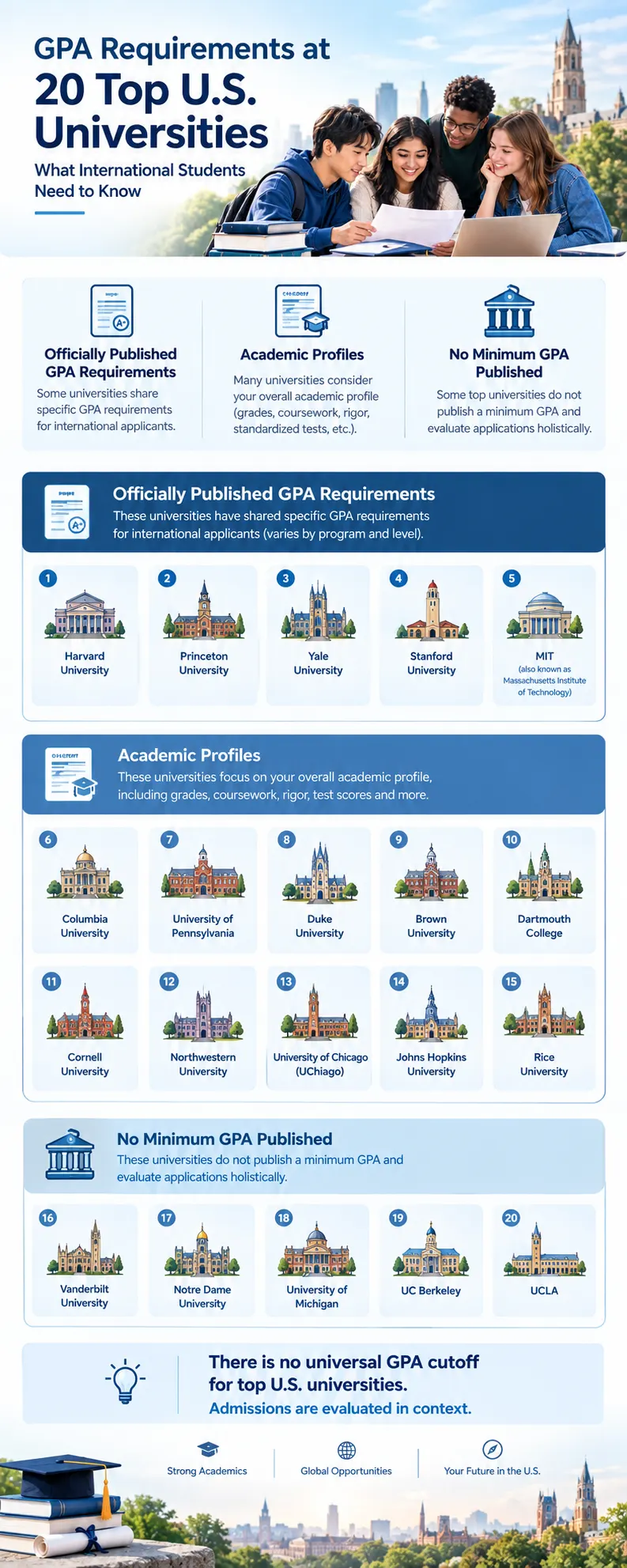
The table below is intentionally labeled “official GPA requirement” rather than simply “required GPA.”
1. Harvard University
Harvard does not publish an official minimum GPA requirement for first-year admission. The university evaluates academic achievement alongside activities, life experiences and other factors. International applicants are reviewed under the same application requirements as U.S. applicants. (Harvard College)
| Official GPA requirement | Average GPA of Admitted Students |
| No official minimum GPA requirement | Unweighted GPA: 3.9 to 4.0 Weighted GPA: 4.15 and 4.25 |
2. Princeton University
Princeton does not have a formal minimum GPA requirement. Instead, the university evaluates your academic record within the context of your school, curriculum, and educational system. (Princeton University Admission)
| Official GPA requirement | Average GPA of Admitted Students |
| No formal minimum GPA requirement | Unweighted GPA: 3.9 or higher |
3. Yale University
Yale does not specify a minimum GPA or a required number of advanced courses for admission. The university looks at your transcript, curriculum, academic performance, and school context when evaluating your preparation. (Undergraduate Admissions)
| Official GPA requirement | Average GPA of Admitted Students |
| No specific minimum GPA | Unweighted GPA: around 3.95 |
4. Stanford University
Stanford does not publish an official minimum GPA requirement. Academic excellence is an important part of the application, but Stanford evaluates grades and course rigor in the context of the student’s school and educational opportunities. (Stanford University Admission)
| Official GPA requirement | Average GPA of Admitted Students |
| No official minimum GPA requirement | Unweighted GPA: Between 3.95 and 4.0 Weighted GPA: 4.3 to 4.8 |
5. Massachusetts Institute of Technology (MIT)
MIT does not publish a GPA cutoff for first-year admission. The university evaluates international students within the context of their own educational systems and does not expect them to convert their grades into the American grading system. (MIT Admissions)
| Official GPA requirement | Average GPA of Admitted Students |
| No published GPA cutoff | Unweighted GPA: Between 3.95 and 4.0 |
6. Columbia University
Columbia does not publish a strict minimum GPA requirement for first-year admission. Academic preparation is a major part of its holistic review, and the university considers the rigor of a student’s coursework along with other aspects of the application.(Columbia Undergraduate Admissions)
For additional context, 94% of enrolling students in Columbia’s Class of 2028 who attended schools reporting class rank were in the top 10% of their graduating class. This shows why international students should consider their academic standing within their own school rather than focusing only on a converted GPA.
| Official GPA requirement | Average GPA of Admitted Students |
| No strict official minimum GPA requirement | GPA between 3.5 and 4.0 |
7. University of Pennsylvania
The University of Pennsylvania does not publish a minimum GPA for admission. The university evaluates academic preparation, coursework, and the overall application.
International applicants should pay particular attention to Penn’s guidance on academic records. Penn states that international grades, GPAs, and test scores should not be recalculated by applicants or third-party agencies. So, if your school uses a different grading system, don’t automatically convert your GPA to 4.0 unless the university specifically instructs you to do so. (Penn Admissions)
| Official GPA requirement | Average GPA of Admitted Students |
| No minimum GPA for admission | Unweighted GPA: Between 3.9 and 4.0 |
8. Duke University
Duke does not publish a universal GPA cutoff for first-year admission. Instead Duke reviews individual grades, overall GPA, class rank when available, course rigor and the opportunities available to the student. (Duke Undergraduate Admissions)
| Official GPA requirement | Average GPA of Admitted Students |
| No published universal GPA cutoff | Unweighted GPA: Around 4.0 Weighted GPA: 4.2 |
9. Brown University
Brown does not publish a minimum GPA requirement. Instead it uses contextual, holistic review and does not use a minimum test score as an admission cutoff. (Brown University Admissions)
| Official GPA requirement | Average GPA of Admitted Students |
| No published minimum GPA | Unweighted GPA: 3.9 or higher Weighted GPA between: 4.0 and 4.3 |
10. Dartmouth College
Dartmouth does not require a minimum GPA for admission. Instead the university explicitly says each application is reviewed holistically regardless of GPA and considers rigor and grade trends. (Dartmouth Admissions)
| Official GPA requirement | Average GPA of Admitted Students |
| No minimum GPA | Unweighted GPA: 3.9 or higher |
11. Cornell University
Cornell does not publish a universal GPA cutoff for first-year applicants. Because the university evaluates applicants through its colleges/schools and considers academic preparation, coursework and the overall application. (Cornell Undergraduate Admissions)
| Official GPA requirement | Average GPA of Admitted Students |
| No universal GPA cutoff published | Unweighted GPA: 3.8 to 4.0 |
12. Northwestern University
Northwestern does not publish a minimum GPA requirement for first-year admission. International applicants follow the same general application process as domestic applicants, while their academic credentials are evaluated in context. (Northwestern Undergraduate Admissions)
| Official GPA requirement | Average GPA of Admitted Students |
| No published minimum GPA | Unweighted GPA: 3.9 to 4.0 Weighted GPA: Around 4.18 |
13. University of Chicago
The University of Chicago does not publish a minimum GPA requirement or a required test score for admission. It uses holistic admission rather than a simple GPA threshold. (Chicago University)
| Official GPA requirement | Average GPA of Admitted Students |
| No minimum GPA or required test score | Unweighted GPA: 3.7 to 4.0 |
14. Johns Hopkins University
Johns Hopkins does not publish a universal GPA cutoff for first-year undergraduate admission. Academic preparation is considered as part of a broader admissions review. (Johns Hopkins Admission Requirement)
Be careful when you see a 3.0 GPA requirement associated with Johns Hopkins online. Some individual graduate programs publish their own GPA requirements, but those requirements should not automatically be treated as undergraduate admissions standards.
| Official GPA requirement | Average GPA of Admitted Students |
| No published universal GPA cutoff | GPA: At least 3.0 on 4.0 scale |
15. Rice University
Rice’s published graduate admissions information includes a 3.0 GPA benchmark, but this should not be confused with an undergraduate admission requirement.
Rice says it considers rigor, academic performance, extracurricular achievements, essays and other factors in a holistic review. Its latest Class of 2029 profile reports an 8.0% admission rate. (Office of Admission | Rice University)
| Official GPA requirement / academic profile | Average GPA of Admitted Students |
| At least a 3.0 (B) grade point average | 3.85 to 4.00 |
16. Vanderbilt University
Vanderbilt does not publish an official GPA requirement for undergraduate admission. However, international students applying to graduate programs should check the requirements of the specific school or program. (Vanderbilt University)
For example, Vanderbilt Graduate School requires an undergraduate GPA (UGPA) and asks applicants with undergraduate education outside the U.S. to calculate their UGPA on a 4.0 scale using its specified process. This is a good example of why GPA conversion rules can differ between undergraduate and graduate admissions.
| Official GPA requirement | Average GPA of Admitted Students |
| No official GPA requirement | Minimum 3.0 GPA on 4.0 scale |
17. University of Notre Dame
Notre Dame does not have a minimum GPA or class-rank requirement for admission. The university says competitive applicants generally have strong grades, rigorous coursework, and high academic standing within their school. (Undergraduate Admissions)
Importantly for international students, Notre Dame does not require applicants to recalculate their GPA to a 4.0 scale.
| Official GPA requirement | Average GPA of Admitted Students |
| No minimum GPA or class-rank requirement | Minimum 3.0 GPA on 4.0 scale |
18. University of Michigan–Ann Arbor
Michigan does not guarantee admission based on any particular GPA. The university has reported an average unweighted GPA of approximately 3.92 for a previous incoming class, but that figure is an academic profile rather than an admission requirement.
Michigan also provides country-specific academic guidance for international applicants. (University of Michigan Admissions)
| Official GPA requirement | Average GPA of Admitted Students |
| No GPA guarantees admission | Previous incoming class average was 3.92 unweighted |
19. UC Berkeley
UC Berkeley has a minimum GPA requirement of 3.0 for California residents and 3.4 for nonresidents in the specified A-G coursework. However, meeting the minimum does not mean that you are automatically competitive for admission.
For the 2026 entering class, Berkeley reported a middle 50% unweighted GPA range of 3.90–4.00. Berkeley also advises international applicants not to convert their grades. (Office of Undergraduate Admissions)
| Official GPA requirement / academic profile | Average GPA of Admitted Students |
| Minimum 3.0 for California residents and 3.4 for nonresidents in specified A-G coursework | 2026 first-year middle 50% unweighted GPA 3.90–4.00 |
20. UCLA
The minimum GPA requirement for California residents is 3.0 and 3.4 GPA for nonresidents which is same as University of California’s minimum academic requirement.
However, the minimum is not the same as a competitive GPA. Among Fall 2025 admits, UCLA reported a 4.0 average unweighted GPA. UCLA also considers academic performance in the context of the opportunities available to each student. (Undergraduate Admission)
| Official GPA requirement | Average GPA of Admitted Students |
| UC minimum: 3.0 for California residents. 3.4 GPA for nonresidents in A-G coursework; | Fall 2025 admits had a 4.0 average unweighted GPA |
How to read this table?
Notice something important: most universities do not give you a number such as “3.7 or higher.”
That does not mean grades are not important.
Quite the opposite.
At highly selective universities, academic performance is often a foundational part of the application. The difference is that admissions offices want to know what your grades represent.
A 3.8 earned in a highly demanding curriculum may tell a different story from a 3.8 earned in a school with very different grading practices. Likewise, a student with a 92% average in a national examination system should not assume that an admissions officer will simply turn 92% into a U.S. GPA and compare that number with every other applicant.
Do Top U.S. Universities Require a 4.0 GPA?
No, there is not any universal rule to have a 4.0 GPA requirement for non-U.S. students.
However, students should not interpret “no minimum GPA” as “any GPA is equally competitive.”
At highly selective universities, successful applicants are generally strong students who have challenged themselves academically when those opportunities were available.
The important distinction is between four different ideas:
1. Minimum GPA
A minimum GPA is an official threshold that must be met for an applicant to be eligible.
For example, UC Berkeley requires a 3.0 GPA in qualifying A-G courses for California residents and requires 3.4 GPA for nonresidents. But Berkeley also warns that meeting the minimum is often not enough to be competitive. (Office of Undergraduate Admissions)
2. Competitive GPA
A competitive GPA describes the academic level commonly associated with applicants who are strong candidates.
This is not the same as a guaranteed admission threshold.
3. Average GPA
An average describes a group of students.
For example, the University of Michigan reports a 3.92 average GPA for its previous incoming first-year class. Michigan specifically says that no particular GPA guarantees admission. (University of Michigan Admissions)
4. Middle-50% GPA range
A middle-50% range describes the GPA range covering the middle half of a particular group.
UC Berkeley’s 2026 first-year student profile reports an unweighted GPA range of 3.90–4.00 for the middle 50% of its admitted class. Berkeley explicitly says these figures are not benchmarks. (Office of Undergraduate Admissions)
These statistics are useful for understanding the academic profile of a university, but they should not be turned into fake admission cutoffs.
Should International Students Convert Their GPA to a 4.0 Scale?
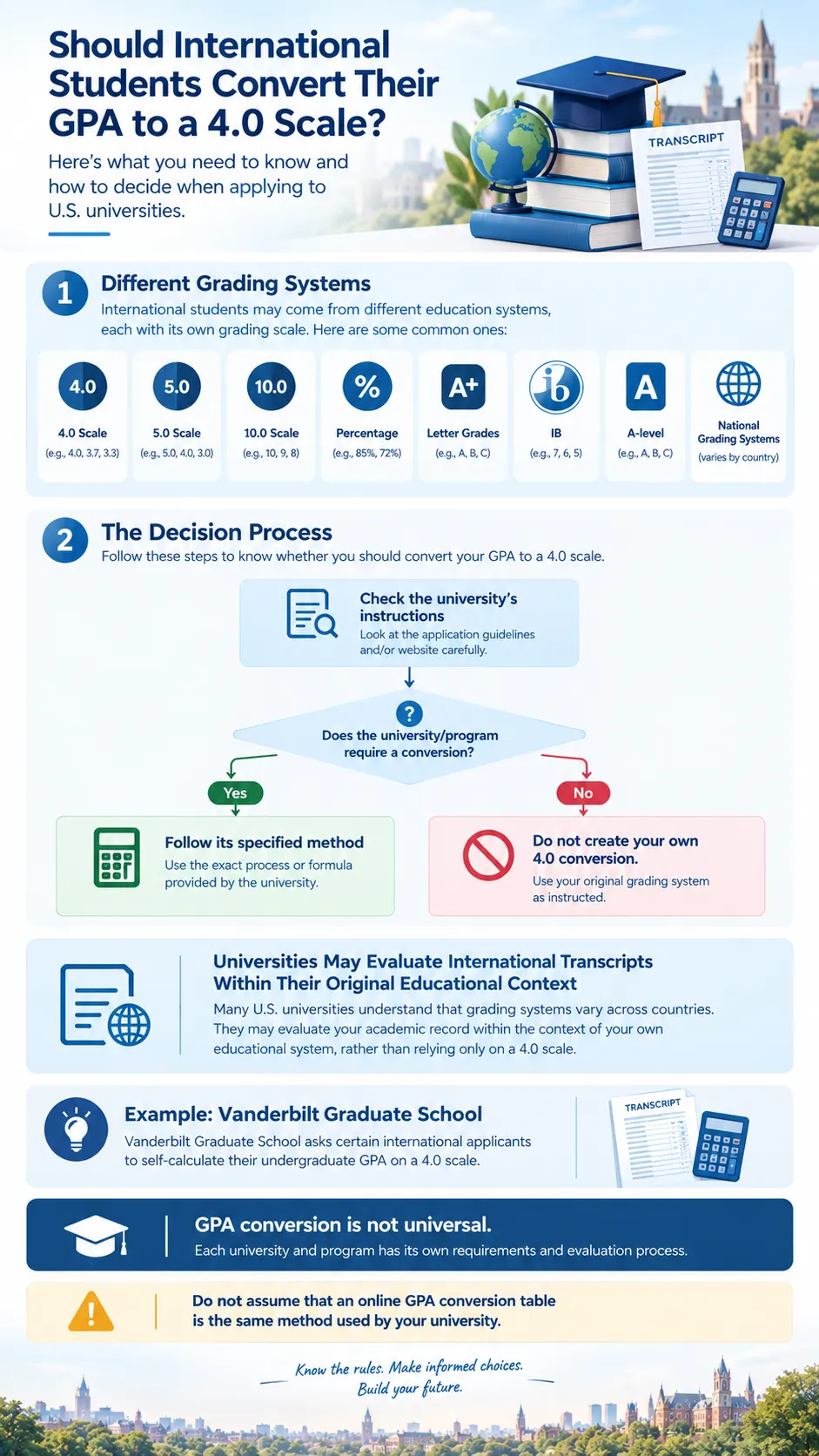
This is one of the most important things international applicants need to understand. Usually, you should not automatically convert your GPA to a U.S. 4.0 scale.
A university may understand your country’s grading system better than a homemade conversion does. Several major universities explicitly tell international applicants not to perform their own GPA conversions.
Stanford
Stanford evaluates international students in the context of their educational systems and does not expect students to manufacture an American GPA simply for the application.
The underlying transcript and academic record provide more information than a single converted number.
Princeton
Princeton says an international student’s academic record is evaluated within the context of the student’s educational system and school curriculum.
If the student’s school or education system does not normally provide a GPA, Princeton says it does not expect the applicant to create a conversion. (Princeton University Admission)
MIT
MIT is particularly clear.
Its admissions officers are trained to understand different international education systems. MIT says it does not try to convert international grades to the American system or find an equivalent. (MIT Admissions)
That means a student should not take an international transcript and invent a U.S. GPA just because MIT is located in the United States.
University of Pennsylvania
Penn says international transcripts do not need third-party evaluation and that applicants’ grades, GPAs and test scores should not be recalculated.
Penn also explains that admissions officers consider the applicant’s educational system and local opportunities when reviewing the academic record. (Penn Admissions)
Caltech
Caltech says its admissions officers are trained to understand applicants’ education systems and that international applicants do not need to translate or convert grades into the American system. (Caltech Admissions)
UC Berkeley
Berkeley gives unusually direct instructions: Do not attempt to convert your grades.
International students should report their grades exactly as they appear on their school records and select the grading scale used by their school. (Office of Undergraduate Admissions)
Notre Dame
Notre Dame says it receives applications from more than 100 countries and evaluates international applications in their educational context. Students should report the grading scale their school uses rather than recalculate their GPA to 4.0. (Undergraduate Admissions)
Vanderbilt Graduate School: An Important Exception
Vanderbilt University’s Graduate School currently requires applicants to report an undergraduate GPA (UGPA). It says international applicants who completed all or part of their undergraduate education must self-calculate their UGPA on a 4.0 scale. (Vanderbilt Graduate School Application Requirements)
While applying in Vanderbilt you also need to include information about your institution’s grading scale along with the transcripts.
What If My School Uses Percentage Instead of GPA?
If your school is using Percentage as a score instead of GPA then you are not alone. Other country school may use:
- A 10-point CGPA
- A 5-point GPA
- A-level grades
- International Baccalaureate scores
- National examination grades
- Letter grades
- A country-specific grading system
That is not automatically a problem since universities that regularly admit international students are accustomed to reviewing different educational systems.
For example: The University of Michigan publishes country-specific requirements covering grading systems such as India, China, the United Kingdom, France, Australia and many others. (University of Michigan Admissions)
Similarly Princeton asks international students to provide the academic records and external examination results appropriate to their education system. (Princeton University Admission)
The important thing is to follow the application instructions for the university you're applying to.
If the university accepts your grades exactly as they appear on your transcript, do that. If a particular university asks for a converted GPA, follow the stated method rather than choosing a random online conversion chart.
Want to understand your numbers on another scale?
If you’re simply trying to understand what your GPA or percentage represents mathematically, you can use our GPA to Percentage Converter as a reference.
Just remember: a mathematical conversion is not necessarily the number a U.S. university will use when evaluating your application.
What Matters Besides GPA?
So, what if your GPA isn’t perfect? Does that mean you don’t have a chance at a top U.S. university?
Your GPA is important, but admissions officers look at much more than one number. They want to understand how challenging your courses were, how you performed over time, what opportunities your school offered, and what you could bring to the university beyond the classroom.
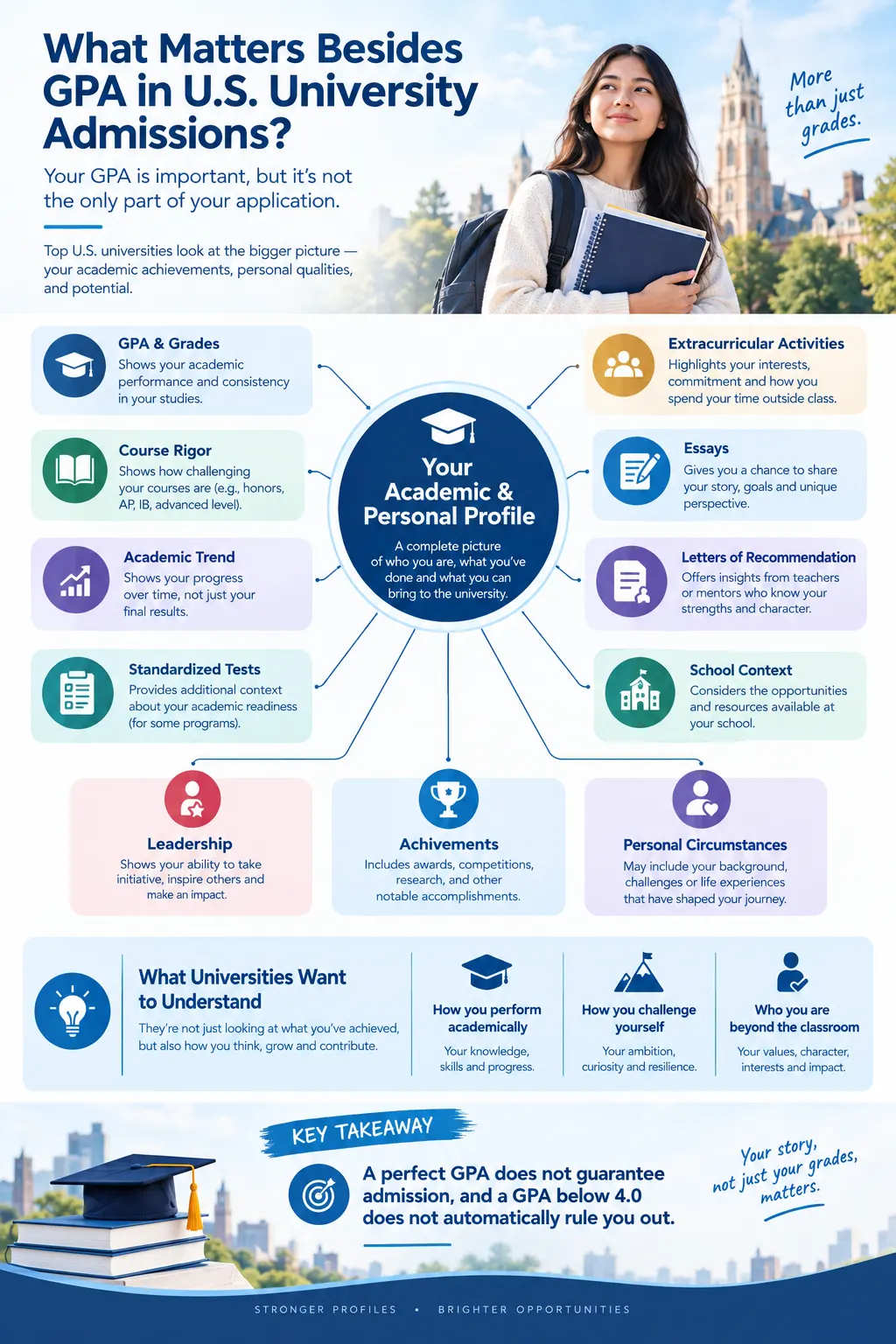
Depending on the university, other parts of your application can include:
1. Curriculum Rigor
Universities want to know whether you have taken the most challenging courses available to you, such as AP, IB, A-level, honors, or advanced courses?
Some examples of the such courses are:
- Advanced Placement courses
- International Baccalaureate courses
- A-level subjects
- Honors or advanced classes
- Higher-level mathematics
- Advanced science
- University-level coursework
- Rigorous national curriculum
But there is an important qualification. You can’t take a course your school does not offer.
Yale university explicitly says students are expected to take advantage of available challenging courses. It evaluates the student’s curriculum within the context of what was actually available. (Undergraduate Admissions)
So you should not worry that a lack of AP courses automatically puts you at a disadvantage if your school does not offer AP.
2. Grade Trends
Admissions officers don’t only look at the final GPA. They may also look at your grade trends to check whether it is improving, staying consistent, or declining over time.
A student whose grades improve significantly may tell a different academic story from a student whose performance steadily declines.
For example: Dartmouth College considers grade trends when evaluating a student’s academic trajectory.
3. Standardized Tests
If the university requires or considers SAT or ACT scores, a strong result can provide additional evidence of your academic preparation. However, testing policies vary widely from one university to another, so it’s important to check the requirements for each school you’re applying.
If you’re trying to understand how the PSAT and SAT relate to each other, including score ranges and what a PSAT score may indicate about SAT performance, our PSAT vs SAT guide can help.
For example:
- Harvard currently requires SAT or ACT, with limited alternatives in exceptional circumstances when those tests are inaccessible.
- MIT requires SAT or ACT for first-year applicants.
- UCLA does not consider SAT or ACT scores for admission or scholarship purposes.
- Cornell currently requires SAT or ACT for first-year applicants.
Keep in mind: a strong test score can strengthen an application, but it doesn’t replace a solid academic record. Universities consider test scores alongside your grades, course rigor, and the rest of your application.
4. Extracurricular Activities
A strong academic record is important, but top U.S. universities also want to know who you are beyond your grades. How do you spend your time when you’re not studying? What interests you enough to pursue on your own? Have you taken responsibility, helped others, built something, or stuck with an activity over time?
Your extracurricular activities can help admissions officers see those parts of your story.
And “extracurricular” doesn’t necessarily mean joining as many school clubs as possible. Depending on your circumstances and opportunities, meaningful activities might include:
- Research or academic projects
- Sports and athletics
- Music, theater, or other performing arts
- Debate or public speaking
- Entrepreneurship or a small business
- Community service or volunteering
- Student clubs and organizations
- Part-time or full-time employment
- Family responsibilities or caring for relatives
- Independent projects
- Leadership roles
- Art, writing, or other creative work
You don’t need a long list of extra activities. Ten unrelated club memberships may tell admissions officers less about you than one or two activities you’ve pursued seriously for several years.
What matters is the depth, commitment, initiative, and context behind what you do. If you had limited opportunities at your school, universities can consider that context too.
So instead of asking, “How many extracurricular activities should I have?”, ask yourself: “What have I genuinely cared about, and what have I done with the opportunities available to me?”
5. Essays
Your essays give admissions officers a chance to understand your experiences, goals, personality, and perspective that numbers and grades cannot capture. Through your essays, admissions officers can learn more about:
- How you might contribute to the university community
- How you think and approach ideas
- What genuinely motivates you
- How you have responded to challenges or setbacks
- What experiences have shaped you
- What matters to you and why
- What you have learned from your experiences
For example: Harvard explicitly says it wants to understand the person behind the numbers rather than evaluate applicants only through academic statistics
6. Letters of Recommendation
Your grades show admissions officers how you performed academically, but a recommendation letter can add the personal context behind those grades. Teachers and counselors can describe qualities that are difficult to see from a transcript alone.
A thoughtful recommendation can help explain where you stand within your school and what kind of student you are day to day. A strong recommendation may give insight into:
- Your academic strengths and areas of growth
- Intellectual curiosity and enthusiasm for learning
- How you participate and contribute in class
- How you respond to feedback or difficult work
- Character, responsibility, and maturity
- Leadership and collaboration
- Your contribution to the school community
- How your academic performance compares with other students at your school
So, when choosing a teacher or counselor, don’t focus only on who gave you the highest grade. Consider who knows your work, growth, character, and potential well enough to describe you honestly and specifically.
How to Think About Your GPA as an International Student ?
Your GPA only makes sense when you look at how it was calculated, how challenging your courses were, how you performed compared with your classmates, and what opportunities your school gave you.
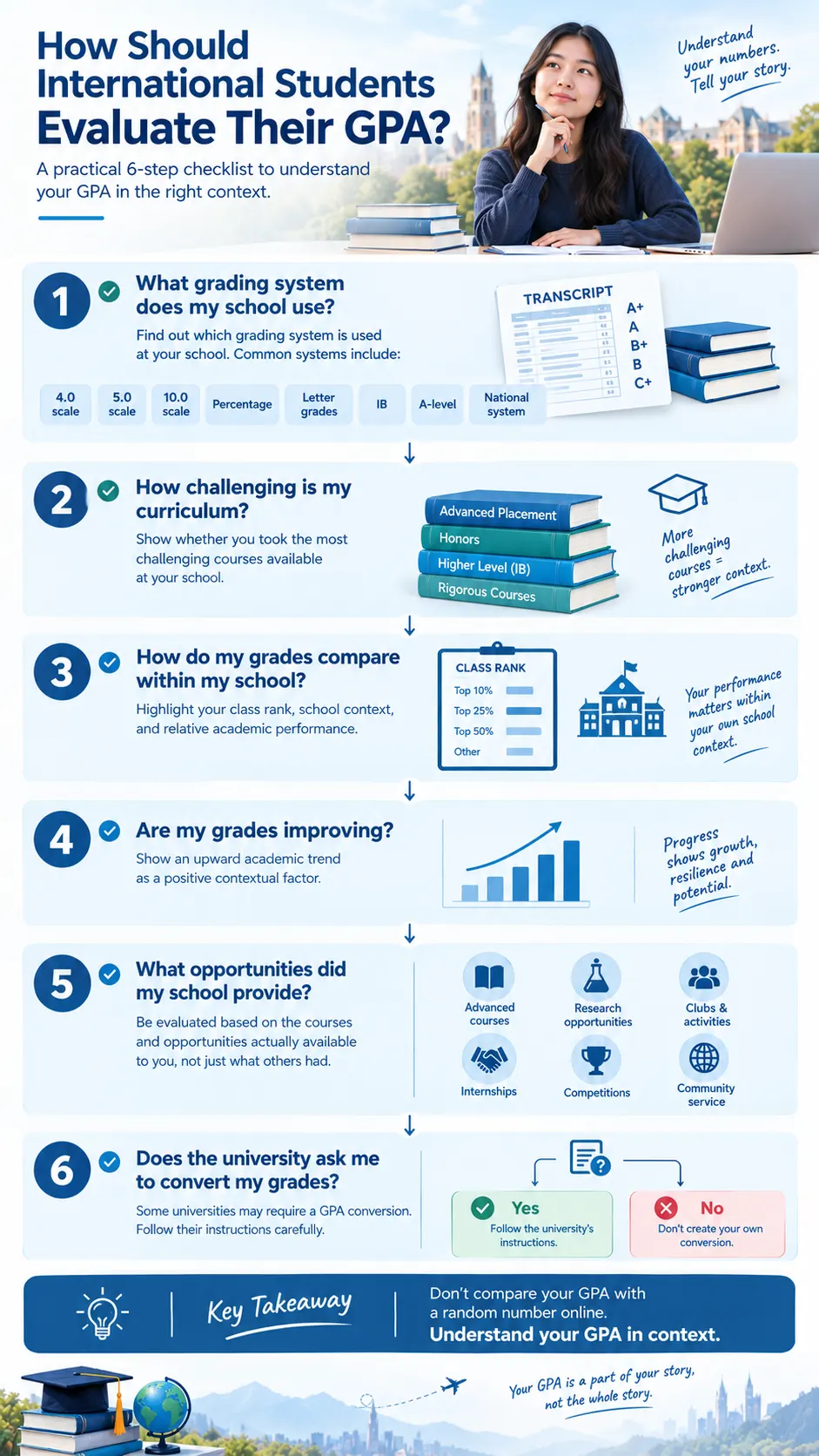
Before deciding whether your GPA is “good enough,” ask yourself these questions:
1. What grading system does my school use?
First, understand how your school actually measures academic performance.
Do you receive grades on a:
- 4.0 scale?
- 5.0 scale?
- 10.0 scale?
- 100-point scale?
- Letter-grade system?
- IB grading system?
- A-level system?
- National examination system?
A GPA or percentage cannot always be compared directly with another grading system. That’s why you shouldn’t assume that a particular number has the same meaning everywhere.
2. How challenging is my curriculum?
Look beyond the GPA itself. What courses did you take to earn it?
Did you choose the most challenging subjects available at your school? Did you take advanced mathematics, science, languages, humanities, AP, IB, A-level, honors, or other demanding courses when they were available?
Universities generally want to see that you challenged yourself within the opportunities your school provided.
3. How do my grades compare with other students at my school?
Your position within your school can provide important context.
Are you near the top of your class? Do you consistently perform better than most students in your grade? Does your school report class rank or another form of academic comparison?
A university may be able to understand your academic performance more accurately when it knows how your grades compare with students studying under the same system.
4. Are my grades improving?
Don’t look only at your final or cumulative GPA. Your academic trend can matter too.
If your grades were weaker during your first year but improved steadily as your courses became more challenging, that progression provides useful context.
On the other hand, a significant decline in grades may raise questions that your application needs to explain.
5. Does the university ask me to convert my grades?
This is one of the most important questions to ask before converting your GPA.
If the university asks you to submit what you received on your school without any conversion then don’t create your own 4.0 conversion.
Different universities can have different approaches to international transcripts. Some evaluate your grades within your original educational system, while particular programs may specifically request a GPA calculation or credential evaluation.
GPA vs. Transcript: Why the Transcript Matters More
One of the biggest mistakes international students make is treating GPA as the entire academic record.
Imagine two applicants:
Applicant A
- GPA: 3.8
- Mostly standard-level courses
- Limited advanced coursework
- Few challenging subjects
Applicant B
- GPA: 3.7
- Highly rigorous curriculum
- Strong advanced mathematics and science
- Excellent grades in difficult courses
- Strong upward academic trend
It would be misleading to conclude that Applicant A is automatically academically stronger simply because 3.8 is greater than 3.7 since addmissions officers can see the courses behind the number.
For example: Yale university has explicitly explained that admissions readers examine the entire transcript rather than reducing it to a single GPA value.
This is why students should consider transcript as an academic story, not just a number.
How International Students Should Compare Universities?
Instead of making your university list based only on GPA, compare these factors:
| Factor | Questions to ask |
| GPA policy | Does the university publish a minimum? |
| Grading system | Does it evaluate international grades in context? |
| Curriculum | Does it expect advanced coursework? |
| Testing | Is SAT/ACT required, optional or not considered? |
| English proficiency | Is TOEFL, IELTS or another test required? |
| Major | Is your intended program especially selective? |
| Cost | Can you realistically afford the university? |
| Financial aid | Is aid available to international students? |
| Location | Is the campus and city a good fit? |
| Career outcomes | What opportunities are available after graduation? |
| Student support | What support exists for international students? |
This produces a much more realistic application strategy than searching for a single “required GPA” factor.
A Note About University Rankings
The phrase “top U.S. universities” can mean different things. Rankings from different organizations use different methodologies, and the order can change from year to year.
For that reason, this guide does not claim that these 20 universities are the only or definitive “top 20” universities in the United States. The list is intended to cover a group of highly selective and widely recognized U.S. universities where GPA questions are especially common among international applicants.
When choosing a university, consider more than its ranking.
A university can be highly ranked and still be a poor fit for your intended major, budget, academic interests or career goals.
Final Takeaway
If you’re an international student searching for GPA requirements for U.S. universities, don’t let a single number determine your entire application strategy.
The most important lessons are:
- There is no universal GPA requirement for top U.S. universities.
- Many highly selective universities publish no minimum GPA.
- A minimum GPA is different from a competitive GPA.
- An average GPA is not an admission cutoff.
- International students should not automatically convert their GPA to 4.0.
- Several universities explicitly evaluate international grades in their original educational context.
- Course rigor matters.
- Grade trends matter.
- School and country context matter.
- Class rank can provide useful context when available.
- Testing policies vary by university and can change.
- A strong GPA does not guarantee admission.
- A GPA below a published competitive profile does not automatically make every U.S. university impossible.
Most importantly, don’t try to turn your entire academic record into one number.
For international admissions, the transcript tells a much bigger story than the GPA printed at the top of the page.
One final reminder: admissions policies, testing requirements and institutional statistics can change. Before submitting an application, always verify the current requirements directly with the university.
Frequently Asked Questions (FAQs)
What GPA do international students need for top U.S. universities?
There is no single GPA requirement that applies to every international student or university. Highly selective universities generally evaluate GPA in the context of your curriculum, school, grading system, course rigor, and overall academic record.
Do international students need to convert their GPA to a 4.0 scale?
Not necessarily. Some universities evaluate international grades within their original educational system, while certain universities or graduate programs may request a 4.0-scale calculation. Always follow the specific instructions provided by the university or program.
Is a 3.7 GPA good enough for an Ivy League university?
A 3.7 GPA can be a strong academic result, but it does not guarantee admission to an Ivy League university. Your curriculum, course rigor, school context, academic trend, extracurricular activities, essays, recommendations, and other factors also matter.
Can a 2.5 GPA get into Harvard?
There is no simple GPA cutoff that answers this question. A 2.5 GPA would generally make admission to Harvard extremely difficult, particularly given the university’s highly competitive applicant pool, but admissions decisions are not based on GPA alone.
Do top U.S. universities care about extracurricular activities?
Yes. At highly selective universities, extracurricular involvement can help admissions officers understand your interests, initiative, leadership, responsibilities, and contribution beyond your academic record.
