Seeing an F on your grade portal is a rough moment. You quickly start thinking about the big questions: Is my GPA ruined? Will I lose my financial aid? Am I going to get kicked out?
Take a breath. One failed class is stressful, but it doesn’t automatically mean you’re out of college or that your degree is out of reach.
What happens next depends on your college’s policies, the course you failed, your current academic standing, and whether you need that class to graduate. In this guide, we’ll cover how much one F can move your GPA, what happens if you fail every class in a semester, when you’ll need to retake a course, and what to do before one bad grade turns into a bigger problem.
What Happens If You Fail a Class in College?
Your school records the F under its grading policy, and a few things can follow:
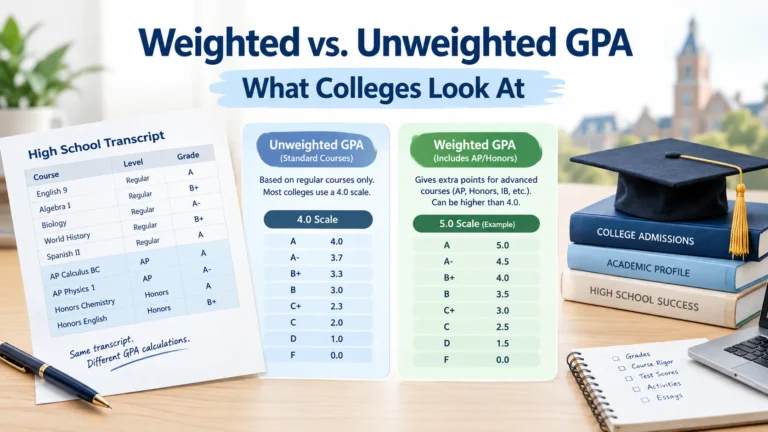
- A lower GPA. On a standard 4.0 scale, an F earns zero grade points.
- Missing credits. You won’t earn credit for a class you may need to finish your degree.
- A required retake. Some courses must be passed before you can graduate or move on to a more advanced class.
- Academic probation. If your performance falls below your college’s standard, you may be placed on probation.
- Financial aid concerns. Some aid programs and scholarships have academic requirements.
- A delayed graduation date. Repeating a required course can shift your schedule.
You probably won’t face all of these. If you fail an elective, you might be able to take another course to earn the missing credits. If you fail a prerequisite, you’ll likely have to repeat it before moving forward.
So the real question isn’t only “did I fail?” but “how does this grade affect what I still need to complete?”
How Bad Is It to Fail a Class?
It can be serious, but it depends on your situation.
If your GPA is strong and you fail one course, you can usually recover through future grades or a repeat-course policy. If your GPA is already close to your college’s minimum, the same F could put you at risk of probation.
The type of course matters too. Failing a required class can slow you down, while failing an elective usually leaves you more flexibility.
Before you assume the worst, find out:
- Is the grade final, or can your current grade still change?
- Is the course required for your major or graduation?
- Do you need to pass it before taking another class?
- Can you retake it, and how will the new grade count?
- Does the F affect your academic standing or financial aid?
One failed class says very little about your ability. But knowing the consequences early gives you time to make smart choices.
How Much 1 F Affect Your GPA?
Since an F earns zero grade points but still counts toward your credit hours, it pulls your average down. The size of the drop depends on your other grades, the credits involved, and how much coursework you’ve already completed.
Here’s the basic formula:
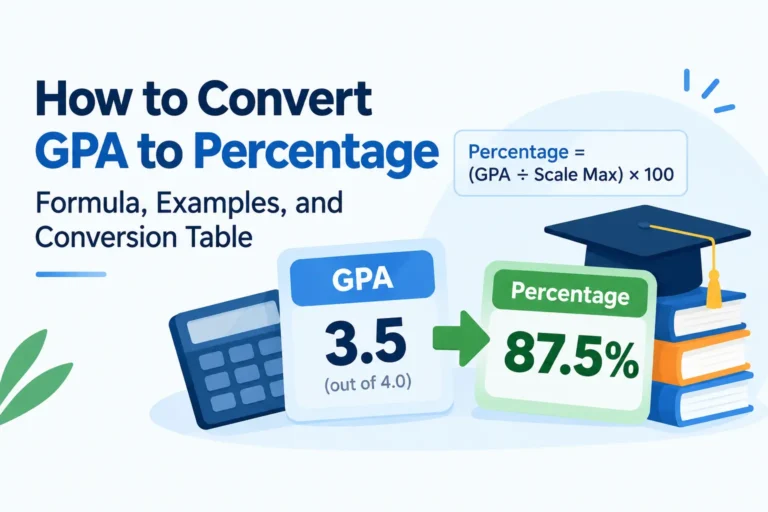
GPA = Total grade points ÷ Total credit hours
Each course’s grade points are multiplied by its credit hours, added together, and divided by the total credit hours.
Example 1: One F in a single semester
Say you take four 3-credit courses. You earn an “A” in three of them and an “F” in the fourth (A = 4.0, F = 0.0).
| Course | Credits | Grade points per credit | Total grade points |
| Course 1 | 3 | 4.0 | 12 |
| Course 2 | 3 | 4.0 | 12 |
| Course 3 | 3 | 4.0 | 12 |
| Course 4 | 3 | 0.0 | 0 |
| Total | 12 | 36 |
So, using the basic formula, your semester GPA is 36 ÷ 12 = 3.00. Without the F, it would have been 4.00.
Example 2: One F on top of an existing GPA
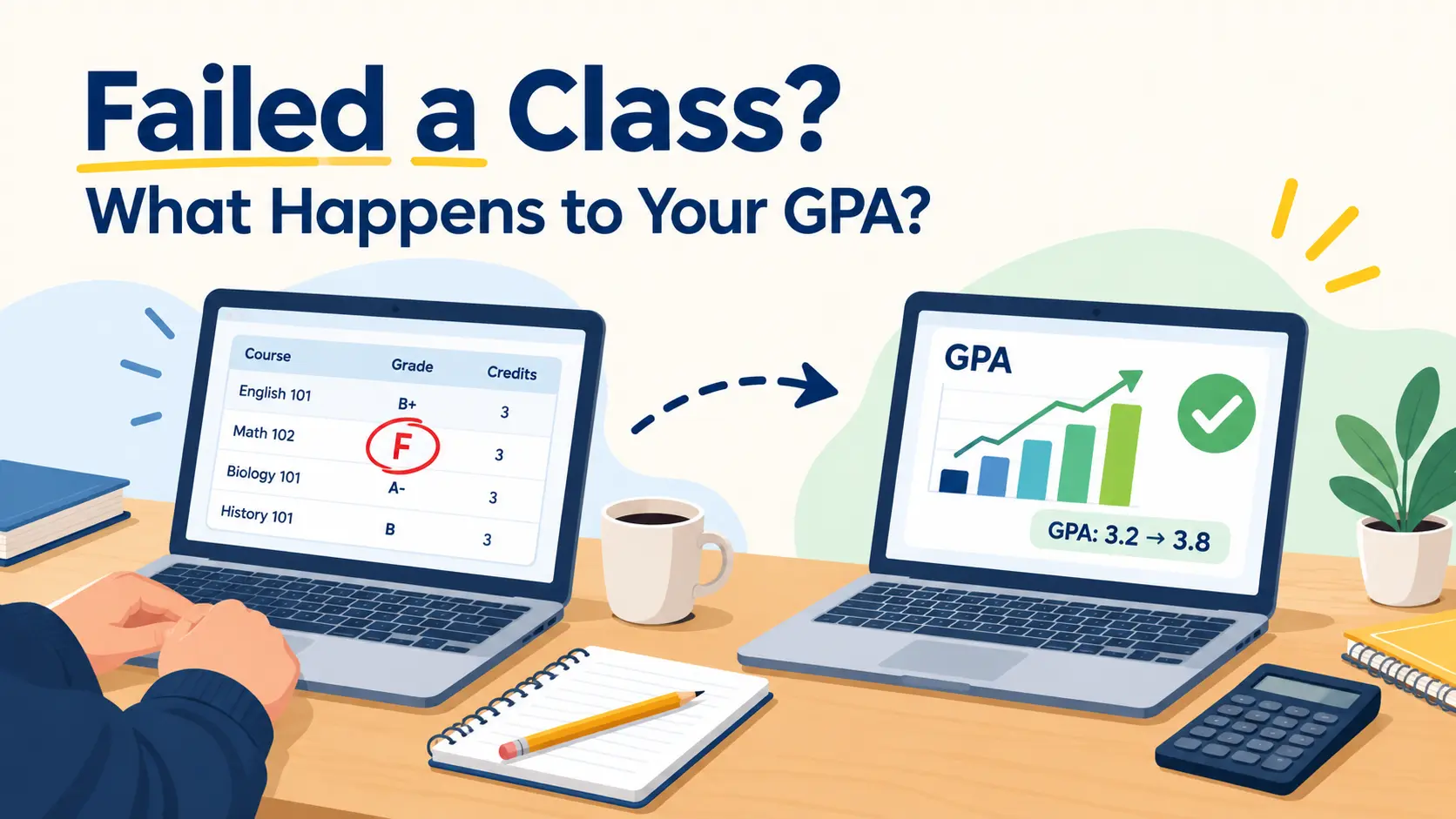
Now say you’ve already completed 30 credits with a 3.2 GPA, which is 96 grade points. You fail a 3-credit course:
96 ÷ 33 = about 2.91
That’s a noticeable drop, but not a catastrophic one. The more credits you’ve already built up, the less a single F moves your cumulative GPA. The same F in your first semester stings more than it would in your third year.
These are illustrations, not predictions. Your result depends on your own credits, grades, and grading scale.
What if your GPA is already low?
An F matters more when you’re sitting close to your college’s minimum GPA. If you’re near the line, one failed course could push you below it. If you’re comfortably above it, you have more room to recover.
Keep in mind that your college’s official calculation always takes precedence, especially if it has special rules for repeated or excluded grades.
A Quick Note from Bipin (Founder of GPAConverter):
“If you’re reading this during finals week, don’t rush to drop your class before checking your school’s withdrawal deadline. Withdrawing after the cutoff date can count as an automatic F on your official transcript anyway, so talk to your advisor first.”
Will You Get Kicked Out of College for Failing One Class?
Usually, no. Colleges tend to look at your academic standing and overall performance, not treat every F as an automatic dismissal.
That said, some programs have stricter rules. In certain degrees or courses, you must pass a specific course before you can continue to the next stage. Your college might also issue an academic warning, place you on probation, or require you to repeat the class. More serious consequences become possible if your performance stays below the school’s requirements.
Check your student handbook or ask your academic advisor which rules apply to you. Don’t assume another college’s policy works the same way.
What Happens If You Fail All Your Classes in One Semester?
This is a bigger deal than failing one class, because you may earn few or no credits while your GPA takes a serious hit.
Depending on your school’s policies and your earlier record, possible consequences include:
- Academic probation, where you may need to meet specific goals.
- Academic suspension, where you could be temporarily blocked from continuing if you don’t meet conditions.
- Delayed graduation, since you may need to repeat several courses or rework your degree plan.
- Financial aid problems, if you no longer meet GPA or course-completion requirements.
- Program restrictions, if your program requires you to pass certain courses to progress.
Failing every course doesn’t necessarily mean immediate expulsion. Some schools give a warning or probation period first, while others handle it differently based on your record and program.
If this has happened to you, contact your academic advisor as soon as you can. Ask whether you can register for next semester, whether you have an appeal option, and what you need to do to get back to good academic standing. If you get an official probation or suspension notice, read it carefully and pay close attention to the deadlines and conditions.
Can Failing a Class Make You Lose Financial Aid?
It can, but one failed class doesn’t automatically mean you lose all your aid.
For U.S. federal student aid, colleges check satisfactory academic progress under their published policies. These usually consider your GPA, the share of attempted credits you actually complete, and how long you’re taking to finish your program. A failed class can affect your progress even if your CGPA stays above the minimum.
Scholarships and other funding often have their own conditions. A merit scholarship might require a specific GPA, while another award might focus on completed credits or enrollment status.
If you receive aid, here’s what to do:
- Contact your financial aid office.
- Ask which academic progress requirements apply to your funding.
- Find out whether the F affects your GPA, your course-completion rate, or both.
- Ask whether a warning, appeal, or academic recovery plan is available.
- Confirm any deadlines before changing your enrollment.
You can also read the official Federal Student Aid guidance on staying eligible for aid.
One caution: don’t withdraw from another course or change your enrollment before checking the academic and financial consequences.
Do You Have to Retake a Failed Class?
You’ll probably need to retake a failed class if the course is required for your degree, is a prerequisite for another class, or must be passed to stay in your program. If it was an elective, you may be able to take a different course to meet the same requirement.
Before you register to repeat a class, check these three things.
1. Will retaking it replace your F?
Repeat-course policies vary a lot. Some colleges let the new grade replace the old one in certain GPA calculations. Others count both attempts or limit how many repeats you get. Even when a retake improves your GPA, the original F often stays visible on your transcript.
Here’s how much the policy can matter. Using the earlier example (30 credits, 96 grade points, then a failed 3-credit course), say you retake the class and earn a “B” grade:
- With grade replacement: (96 + 9) ÷ 33 = about 3.18
- With grade averaging: (96 + 0 + 9) ÷ 36 = about 2.92
Same effort, very different outcome. Enter your own credits into the Multi-Subject CGPA Calculator to see how replacement and averaging change your number. Or you can ask your registrar or advisor how a repeated course affects your GPA, transcript, earned credits, and degree requirements.
2. Will it delay graduation?
If the class is a prerequisite, you can’t take the next course until you pass it. If it’s only offered in certain semesters, you may need to rearrange your schedule. Ask your advisor to review your remaining requirements and find the next opportunity to complete it.
3. What will it cost?
Repeating a course can mean extra tuition, fees, and time, and financial aid rules may affect whether the repeat is covered. Check the costs before you register so you can plan the semester realistically.
What Should You Do If You’re Still Failing a Class?
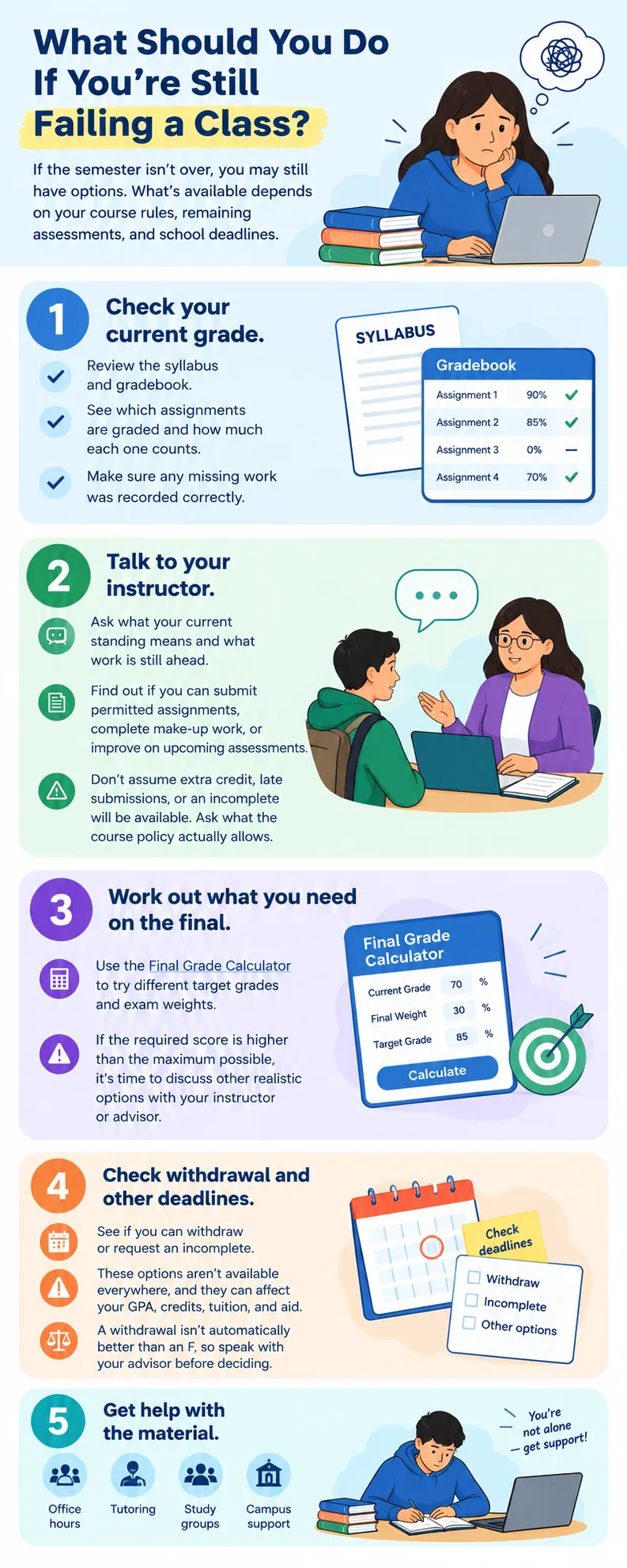
If the semester isn’t over, you may still have options. What’s available depends on your course rules, remaining assessments, and school deadlines.
Step 1: Check your current grade. Review the syllabus and your online gradebook. Confirm which assignments have been graded, how much each one counts, and whether any missing work was recorded correctly.
Step 2: Talk to your instructor. Ask what your current standing means and what work is still ahead. Find out whether you can submit permitted assignments, complete make-up work, or improve on upcoming assessments. Don’t assume extra credit, late submissions, or an incomplete will be available. Ask what the course policy actually allows.
Step 3: Work out what you need on the final. If you know your current grade, the weight of the final exam, and the grade you’re aiming for, you can estimate the score you need. The Final Grade Calculator lets you try different target grades and exam weights. If the required score is higher than the maximum possible, you’ll know it’s time to talk through other realistic options with your instructor or advisor.
Step 4: Check withdrawal and other deadlines. Depending on your situation, you might be able to withdraw or request an incomplete. These options aren’t available everywhere, and they can affect your GPA, credits, tuition, and aid in different ways. A withdrawal isn’t automatically better than an F, so speak with your advisor before deciding.
Step 5: Get help with the material. Use office hours, tutoring, study groups, and other campus support. Focus on the topics you find hardest and build a realistic plan for the assessments that remain. If illness, a disability, a family emergency, or another serious circumstance affected your performance, ask the right campus office about support or formal procedures.
How to Recover After Failing a College Class
Once you understand the consequences, put your energy into what you can change.
- Figure out why you struggled. Was it the material, missed assignments, attendance, time management, or something outside school?
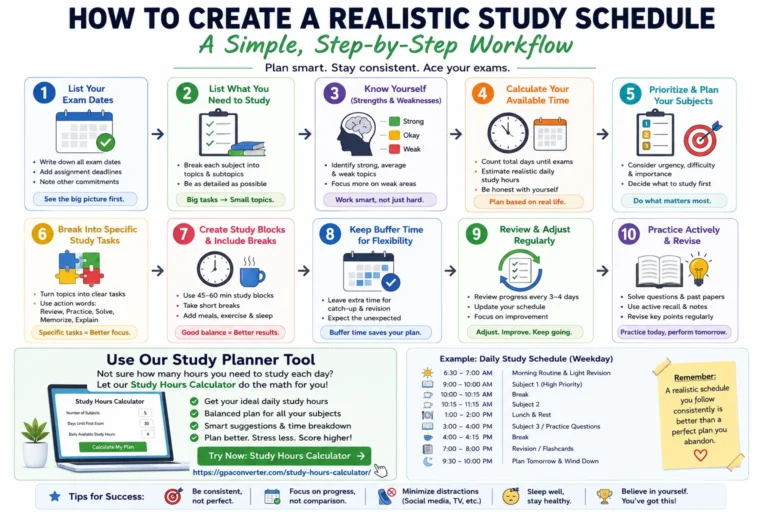
- Build a study routine you can actually keep. A simple study plan you stick to is better than an ambitious one you give up after two weeks.
- Use campus resources. Tutoring, office hours, academic coaching, and counseling can help with the issues behind the grade.
- Rethink your course load. If you were juggling too many classes with work or other responsibilities, ask your advisor about a more manageable schedule. Check the financial aid impact before reducing credits.
- Track your progress. Watch your grades and completed credits through the semester so you can catch problems early.
You don’t have to fix everything at once. Start with one concrete step, like booking an advisor meeting, arranging tutoring, or planning how to repeat a required course.
The Bottom Line
Failing a college class can affect your GPA, degree progress, academic standing, and financial aid. But failing in one class doesn’t automatically mean you’ll be kicked out, and retaking a course doesn’t always erase the original grade.
Start by checking your college’s policies and talking to your instructor or academic advisor. If you receive financial aid, contact that office before making any enrollment decisions.
A failed class is a setback, not a verdict on your ability to finish college. What matters now is understanding your options and acting before deadlines pass.
Frequently Asked Questions
Does one F ruin your college GPA?
No. One F lowers your GPA, but it doesn’t automatically ruin it. The effect depends on your existing GPA, the credits involved, your other grades, and your college’s policies. Strong grades going forward can help you recover.
What happens if you fail one class but pass all your others?
You still earn credit for the courses you passed. The failed course contributes zero grade points and won’t count toward the requirement it was meant to fill. Your final GPA depends on the credit values and your school’s rules.
Can you recover your GPA after failing a class?
Often, yes. Future grades can raise your CGPA, and some colleges have repeat-course policies that change how an earlier grade is counted. How much it helps depends on your academic record and the policy.
Does an F stay on your college transcript?
That depends on your college’s transcript and repeat-course policies. Retaking a course may change how grades count toward your GPA without removing the original attempt from your record. Ask your registrar how both attempts will appear.
Is it better to withdraw from a class or get an F?
There’s no universal answer. A withdrawal and an F can affect your GPA, attempted credits, financial aid, and academic progress differently. Check the withdrawal deadline and talk to your advisor first.
What happens if you fail a prerequisite?
You’ll likely need to pass it before enrolling in the next class. That can affect your schedule and graduation timeline, so ask your department about repeat options and when the course is offered next.