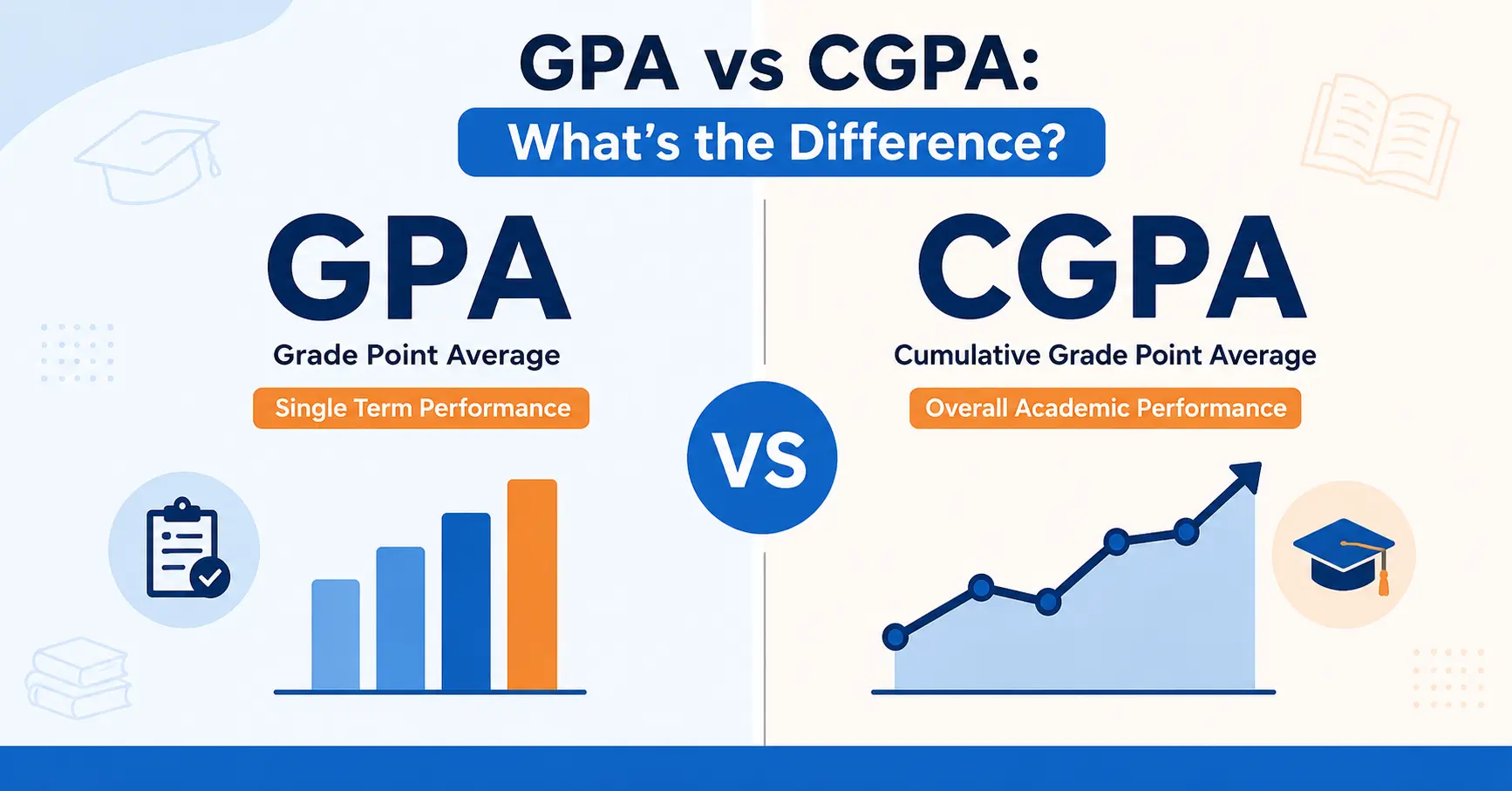
If you’ve ever filled out an application form and paused at a field asking for your “GPA” right after another field asking for your “CGPA”. These two terms are used interchangeably so often in casual conversation, in forum threads, and even sometimes on official forms.
Actually, GPA and CGPA are two genuinely different things. If you are mixing them up on an application, a scholarship form, or a resume, then you are submitting the wrong scores.
In this article, we’re going to help you understand what each one actually represents. Here’s the real difference, explained plainly, with a working example scenario so you can see exactly how they diverge.
What is GPA?
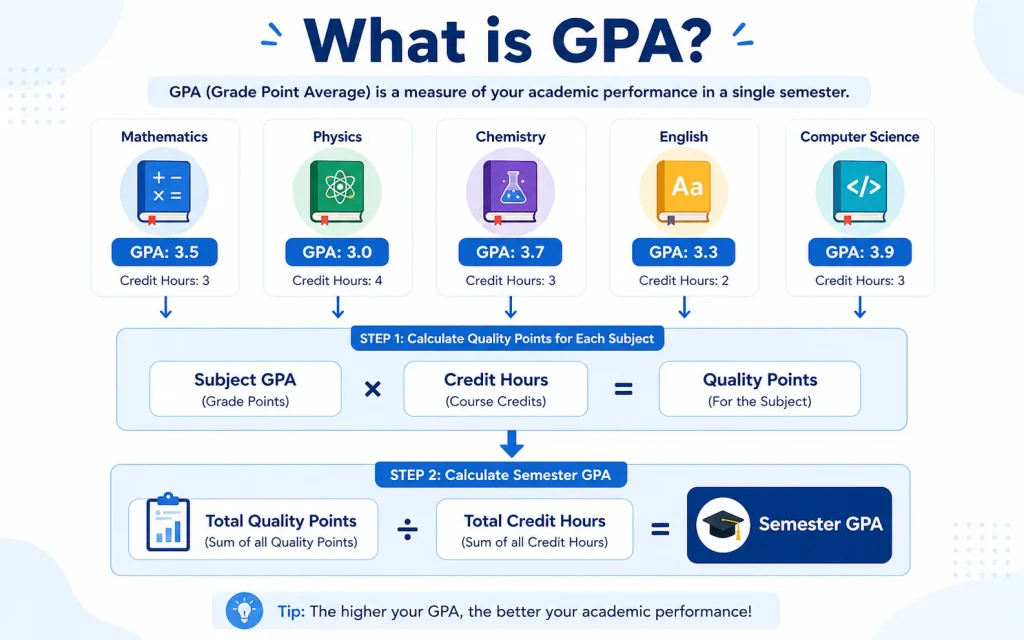
GPA stands for Grade Point Average. It measures your academic performance, marks, and scores over a subject, semester, or term. The grade point value depends on the grading scale of your university or country (such as a 4.0 grading scale where letter grade “A” is 4.0 points, “B” is 3.0 points, “C” is 2.0 points, etc.).
If you are doing a Bachelor’s degree in Computer Science, assume that there are 8 semesters; each semester has 5 subjects or courses. In every semester, you receive a specific letter grade for each subject separately, then converted into a grade point.
Once the grade point for each subject is calculated, your college or university will find your final GPA for a semester in the following way:
- Calculate Subject Points: Multiply each subject’s GPA by its credit hours.
- Calculate Total Quality Points: Add all 5 subject point totals together.
- Calculate Total Credit Hours: Add the credit hours of all 5 subjects together.
- Calculate Semester GPA: Divide the Total Quality Points by the Total Credit Hours.
Based on the above calculation method, the formula for calculating a semester GPA is:
Semester GPA = (GPA₁×CH₁ + GPA₂×CH₂ + GPA₃×CH₃ + GPA₄×CH₄ + GPA₅×CH₅) / (CH₁ + CH₂ + CH₃ + CH₄ + CH₅)
Where:
- GPAₙ = the grade point value for subject n (e.g., 4.0, 3.5, 3.0…)
- CHₙ = the credit hours for subject n
Here is a working example scenario to calculate a semester GPA.
| Subject | GPA | Credit Hours | Quality Points (GPA x Credits) |
|---|---|---|---|
| C Programming | 4.0 | 4 | 16.0 |
| Calculus | 3.0 | 3 | 9.0 |
| Statistics | 3.5 | 4 | 14.0 |
| Information Technology | 2.0 | 3 | 6.0 |
| Math | 4.0 | 1 | 4.0 |
| Total | __ | 15 | 49.0 |
Using the formula for this example:
49.0 Total Quality Points ÷ 15 Total Credit Hours = 3.27 Semester GPA
Your GPA is a snapshot, not a running total. It tells you how you did in that particular semester, and nothing more. If you had a rough first semester and a strong second semester, your two GPAs will look noticeably different from each other, because each one only reflects its own term.
This is also why GPA resets, in a sense, every semester. A new term means a new set of courses, different credit hours, and a new GPA calculated from scratch based only on that term’s grades.
What is CGPA?
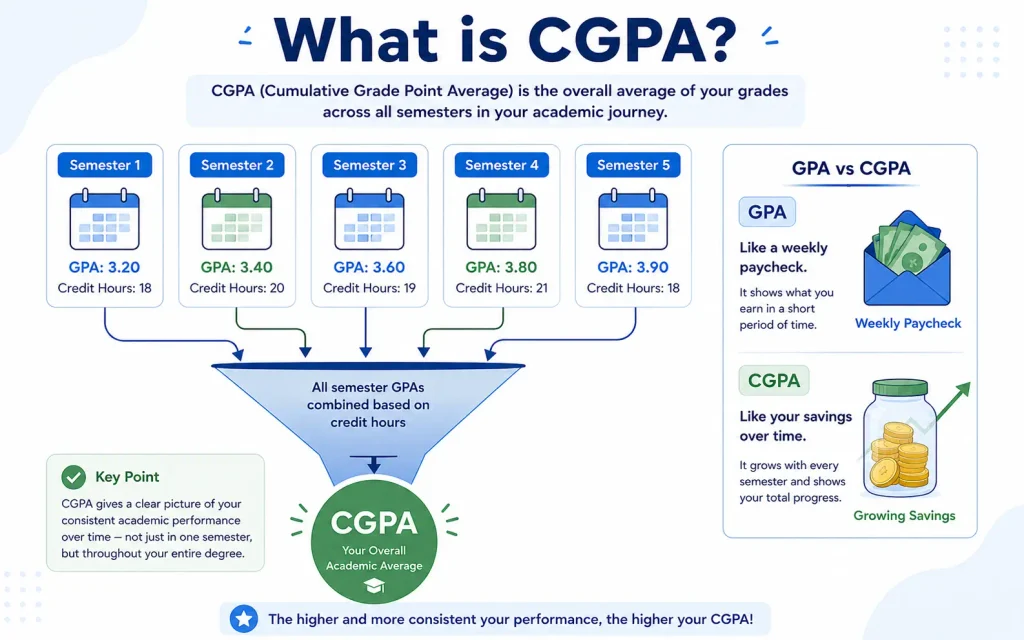
CGPA, or Cumulative Grade Point Average, works differently from a regular GPA. While a typical GPA score gets calculated fresh at the end of each term or semester, CGPA never starts over.
CGPA keeps a running record that combines the grade points and credit hours from every term you’ve finished, building one number that reflects your full academic journey so far.
You can imagine CGPA like a savings account instead of a weekly paycheck. A paycheck shows how much you earned in a specific week, which is your GPA. Your savings balance, though, reflects everything you’ve deposited over time, which is your CGPA.
At the end of your first term or semester, both GPA and CGPA will match exactly because there’s nothing else in the record yet to average in. But once your second term is finished, these two terms start looking different.
Here’s a simple example: imagine you scored a 3.8 in your first semester and then scored only a 2.4 grade point in the second semester. However, your CGPA blends the good first semester with the bad second semester. This keeps your total score at 3.1, which hides the bad score of the second semester.
CGPA Calculation Example
Here is a working example of CGPA calculation. Let’s assume that you have just completed your degree of 5 semesters. You already have the GPA of each semester, and now you want to calculate the final CGPA score by combining all 5 semesters’ grade points.
CGPA = Total Quality Points (all semesters combined) ÷ Total Credit Hours (all semesters combined)
| Semester | Semester GPA | Credit Hours | Quality Points (GPA x Credit Hours) |
|---|---|---|---|
| Semester 1 | 3.8 | 15 | 57.0 |
| Semester 2 | 2.4 | 16 | 38.4 |
| Semester 3 | 3.5 | 15 | 52.5 |
| Semester 4 | 3.9 | 17 | 66.3 |
| Semester 5 | 3.6 | 16 | 57.6 |
| Total | __ | 79 | 271.8 |
Step 1: Multiply each semester’s GPA by its credit hours to get that semester’s Quality Points.
- Semester 1: 3.8 × 15 = 57.0
- Semester 2: 2.4 × 16 = 38.4
- Semester 3: 3.5 × 15 = 52.5
- Semester 4: 3.9 × 17 = 66.3
- Semester 5: 3.6 × 16 = 57.6
Step 2: Add up all the Quality Points: 57.0 + 38.4 + 52.5 + 66.3 + 57.6 = 271.8
Step 3: Add up all the Credit Hours: 15 + 16 + 15 + 17 + 16 = 79
Step 4: Divide Total Quality Points by Total Credit Hours: 271.8 ÷ 79 = 3.44
So, in this case, your CGPA will be 3.44. Have you also noticed how the low score in the second semester (2.4 GPA) barely affects the final CGPA? The semesters with strong scores have balanced things out. This is exactly why we add up all the points and credit hours together, instead of just averaging the five GPA numbers on their own.
GPA Vs CGPA Difference
It’s time to compare how CGPA is different from GPA. To understand the differences easily, we’ll compare these two terms on the basis of the time period covered, whether GPA and CGPA reset after each term or not, usage, and many other key factors.
| Basis | GPA | CGPA |
|---|---|---|
| Time Period | Just one semester or term. | All semesters completed so far. |
| Resets Each Term? | Yes, calculated fresh every semester | No, keeps building on previous terms |
| What It Reflects? | Performance in that specific semester or term only | Overall performance across your whole academic journey |
| Calculation Basis | Subjects and credit hours of one semester | Quality points and credit hours from every semester combined |
| Impact of One Bad Semester | Shows the full drop, since it’s the only data point | Softened, since it’s balanced out by other semesters |
| Stability | Can swing sharply term to term | Stays more steady and consistent over time |
| Used for | Measuring the performance of one term or semester | Judging overall academic standing, admissions, scholarships, job applications |
| Relationship | Is one of the inputs used to calculate CGPA | Is built from all the individual GPAs combined |
| Comparability Across Students | Harder to compare fairly, since course difficulty varies term to term | Easier to compare overall academic strength across a full program |
A Real Example to Show How GPA differs from CGPA?
Let’s take an example of a student who takes courses worth a combined 15 credit hours each semester. The grading scale set by his University is a 4.0 scale.
In the very first semester, he scored a 3.2 GPA. Since this is the first semester, the GPA and CGPA score will remain the same; there’s simply nothing else to average it against yet.
In the second semester, the student earns a 3.8 GPA. Now the CGPA isn’t just 3.8. It’s the combined average of both semesters together, weighted by credit hours. Using the standard CGPA formula, the CGPA after the second semester will be roughly 3.5, sitting neatly between the two individual semester GPAs.
Now imagine the third semester as a very tough semester, where the student’s GPA drops to 2.6. GPA for the 3rd semester would show the full drop. Averaging three semesters together, the CGPA only slips to around 3.2 since the two stronger semesters before it are still carrying weight in the overall calculation.
This is the core behavior you must remember: GPA can swing sharply from semester to semester, while CGPA moves more gradually, because it’s always accounting for your full history, not just your most recent performance.
Which One Do You Actually Need?
This is usually the part that actually matters, since most people looking up “GPA vs CGPA” aren’t asking out of curiosity; they’re staring at a form that asks for one specific number.
Scholarship and Job applications generally ask for CGPA, since scholarship committees typically want to see sustained performance across your entire academic record or degree, not just your performance in the most recent term.
Graduate school applications almost always ask for cumulative GPA, which is functionally your CGPA, sometimes phrased as “overall GPA” or “cumulative GPA” rather than using the term CGPA directly. If a form says “GPA” but is clearly asking about your full academic history rather than one term, it’s asking for your CGPA in practice, even if it doesn’t use that exact word.
Semester progress reports or academic standing checks want your GPA score for that specific term, since the point is to evaluate how you performed recently, not your entire history.
Our Multi-Subject CGPA Calculator lets you enter each of your subjects with their credit hours and grades to calculate your cumulative CGPA across as many semesters as you need, no manual averaging required. If you need to convert either number into a percentage for an application that asks for one instead, the GPA to Percentage Converter handles that across ten different grading scales.
Closing Thoughts
GPA and CGPA aren’t interchangeable, but they’re also not complicated once you know what each one is actually measuring. GPA is your snapshot while CGPA is your running total. The next time a form asks for one or the other, you’ll know exactly which number to reach for and exactly how to calculate it.

I found the explanation of GPA vs CGPA really helpful, especially the distinction between semester GPA and cumulative GPA. Before reading this, I used to think CGPA was simply the average of all my semester GPAs, but the explanation about credit hours makes the difference much clearer. This is a useful reference for students trying to understand their academic results, especially when dealing with university applications or scholarships.
I’m glad to see my explanation helped you to learn the differences clearly. That confusion is pretty common, especially since the two terms are often used interchangeably. Hopefully, the examples make it a little easier to understand in practice.