If you’re preparing for college, you may have taken the PSAT and wondered what your score actually means.
Does it affect your GPA? Is the PSAT easier than the SAT? Can a 1200 PSAT become a 1200 SAT? And if you’re aiming for a highly selective college, is a 1400 SAT enough?
These questions can make the PSAT-SAT relationship seem more complicated than it really is. The simple version is this: the PSAT and SAT are closely connected, but they serve different purposes. Your PSAT or SAT score also does not normally affect your high school GPA.
The PSAT can give you an early look at your performance on the SAT Suite, while the SAT is used for college admissions when a college requires or considers it. Both terms use a common score scale, which makes it easier to track your progress.
Let’s take a closer look at what PSAT and SAT mean, PSAT vs SAT score conversion, difficulty, score ranges, and GPA impact so you know exactly what your score means.
What is SAT?
The SAT, or Scholastic Aptitude Test, is a standardized college admissions test to measure skills that students use in reading, writing, and mathematics. Students can take the SAT to demonstrate their academic readiness as part of the college application process.
The SAT has a score scale range of 400–1600, with 200–800 for Reading and Writing and 200–800 for Math. Unlike the PSAT, which is designed as an earlier-stage assessment within the SAT Suite, the SAT is the test students may submit to colleges when standardized test scores are considered in admissions.
The SAT score can provide colleges with one standardized measure of a student’s academic skills, but it does not represent everything a student knows or determine whether they will be admitted to a particular college.
Your score is considered alongside the rest of your application, depending on the college and its admissions policies.
What is PSAT?
The PSAT, or Preliminary SAT, is a standardized test in the SAT Suite that helps students practice for the SAT and measure their reading, writing, and math skills. It is offered at different levels, including the PSAT 8/9, PSAT 10, and PSAT/NMSQT.
The PSAT/NMSQT is the version most commonly associated with the term “PSAT.” It stands for the Preliminary SAT/National Merit Scholarship Qualifying Test and can also be used to determine eligibility for the National Merit Scholarship Program.
The PSAT is scored on a 320–1520 total score scale, with 160–760 for Reading and Writing and 160–760 for Math. This is different from the SAT’s 400–1600 score range because the tests are designed for students at different stages of their high school education.
Your PSAT score can give you a useful picture of where your skills stand right now. It can help you identify areas that need more attention, see how your performance compares with other students, and understand what you may want to work on before taking the SAT.
However, your PSAT score does not guarantee a particular SAT score. A student who scores 1200 on the PSAT might score 1300 on the SAT after additional preparation, while another student might score around the same or even lower. The point of the PSAT is not to predict your exact SAT result; rather gives information you can use to prepare more effectively.
PSAT vs SAT at a Glance
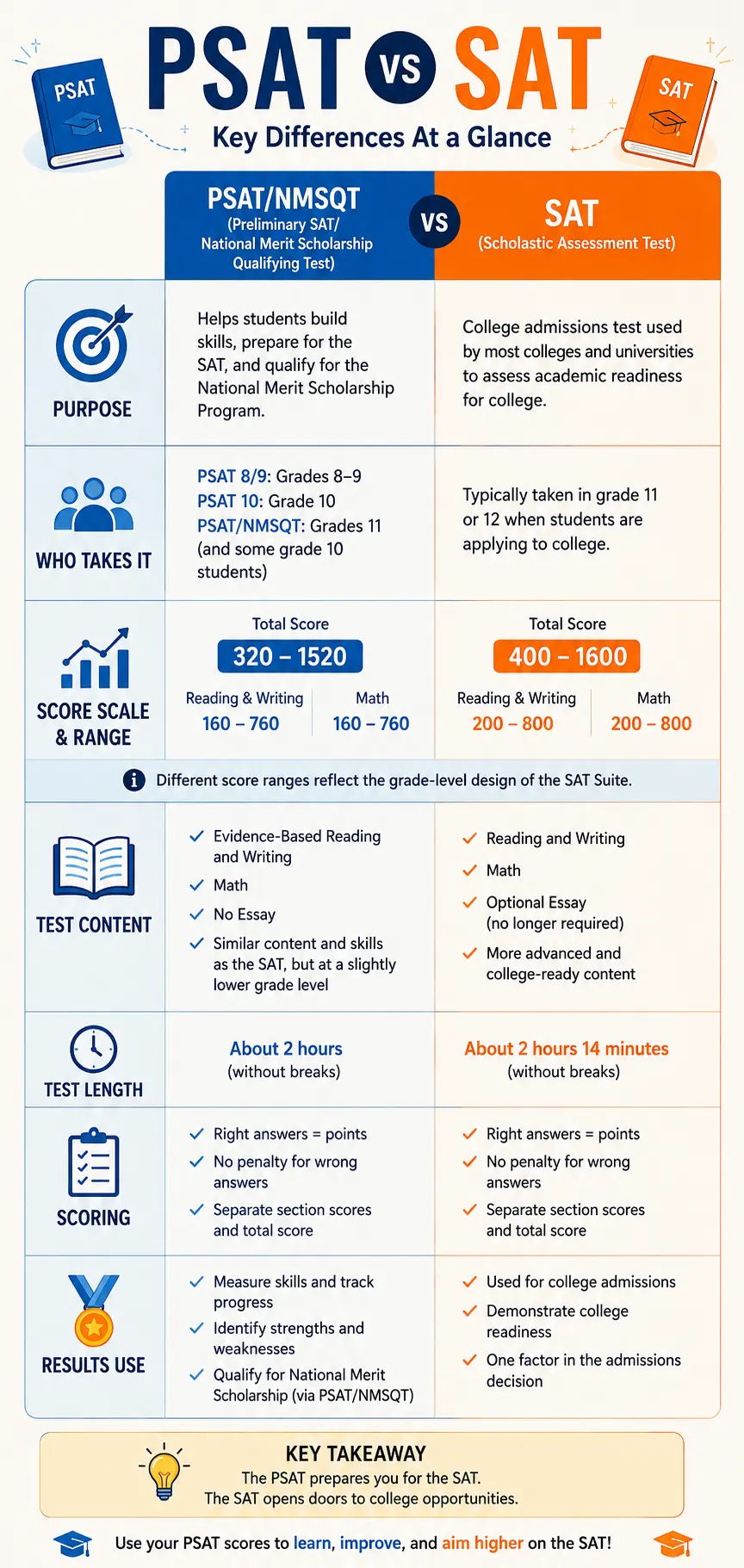
| PSAT/NMSQT | SAT | |
|---|---|---|
| Main purpose | Practice, progress tracking, and National Merit consideration | College admissions |
| Total score range | 320–1520 | 400–1600 |
| Reading and Writing | 160–760 | 200–800 |
| Math | 160–760 | 200–800 |
| Same score scale? | Yes | Yes |
| Affects high school GPA? | Normally no | Normally no |
The College Board reports the PSAT/NMSQT on a 320–1520 total score scale, while the SAT uses a 400–1600 scale. Both have separate Reading and Writing and Math section scores.
One important detail: the PSAT/NMSQT is only one of the PSAT-related assessments. There are also the PSAT 10 and PSAT 8/9, which have different score ranges.
PSAT vs SAT Difficulty: Which Test Is Harder?
The PSAT and SAT are designed for students at different stages of high school, but they assess closely related knowledge and skills. The SAT Suite’s common scale exists partly so students can track growth across these assessments.
For many students, the PSAT may feel easier because it is intended for students earlier in high school.
But "easier" doesn't mean "easy."
A student who has not prepared for the PSAT may still find it challenging. Your experience will depend on your math background, reading ability, familiarity with the test format, and preparation.
Think of the tests as two points on the same path:
- PSAT → practice and progress
- SAT → college admissions
The skills overlap, and the PSAT can show you where you stand before you take the SAT.
PSAT vs SAT Score Conversion: How Does It Work?
This is where the connection between the two tests becomes especially useful. The PSAT and SAT use a common score scale.
College Board explains that this allows scores across the SAT Suite to be compared meaningfully. A given score represents the same level of achievement across the assessments, although each test has a different reported score range.
That means you don’t need to think of PSAT-to-SAT conversion as a complicated equation. For a simple comparison:
- 1200 PSAT → approximately 1200 SAT
- 1400 PSAT → approximately 1400 SAT
- 1470 PSAT → approximately 1470 SAT
But there’s an important catch. Your PSAT score is not a guaranteed SAT prediction.
The common scale tells you what your score represents now. It does not promise that you will earn exactly the same score when you take the SAT months or a year later.
- You might study more.
- You might strengthen your math skills.
- You might become a better reader.
- You might learn how to manage your time more effectively.
- Or you might simply have a better—or worse—test day.
College Board describes the common scale as a way to understand current performance and track growth across the SAT Suite. So a PSAT score is best treated as a starting point, not a final SAT forecast.
Does the PSAT or SAT Affect Your GPA?
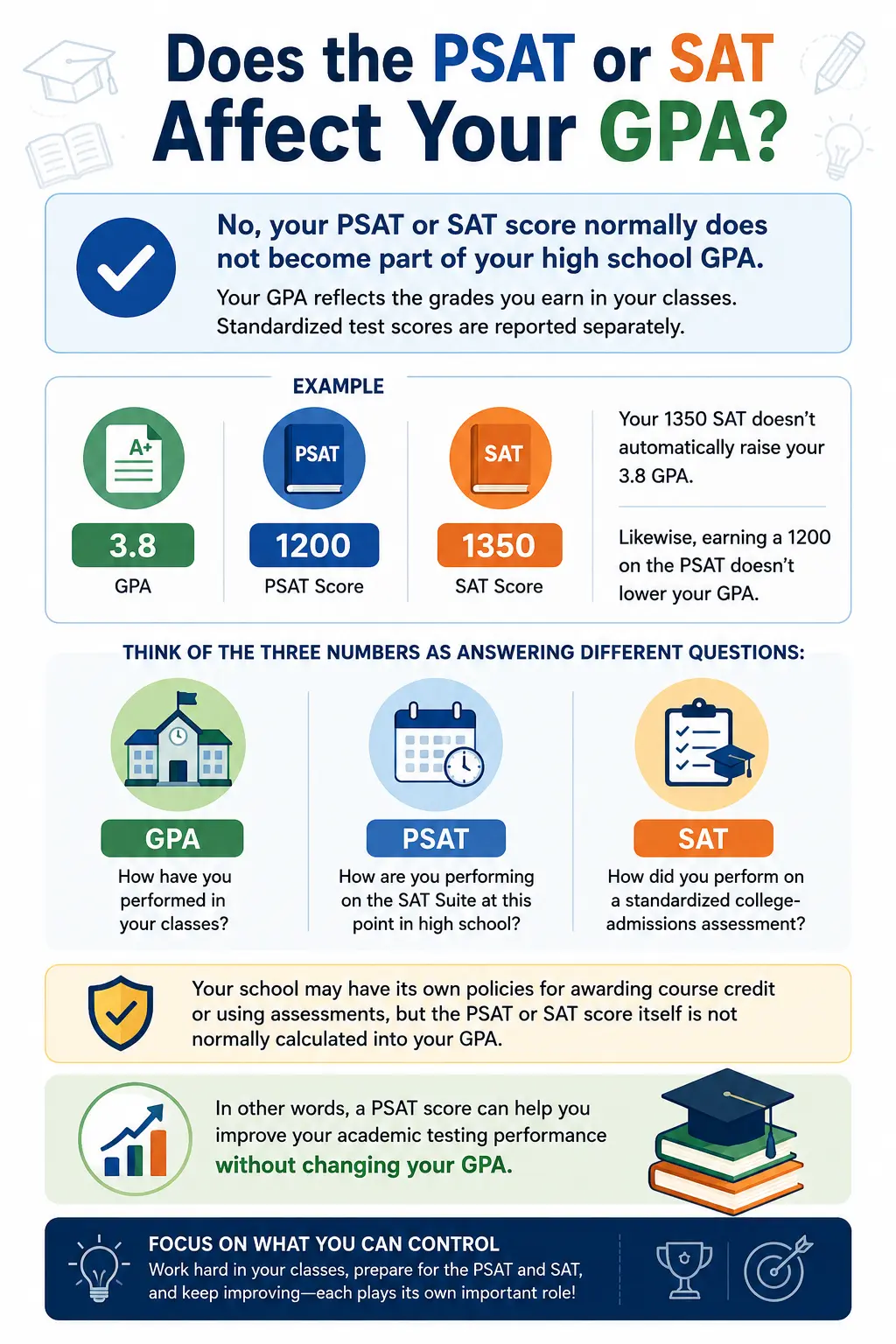
No, your PSAT or SAT score normally does not become part of your high school GPA.
Your GPA reflects the grades you earn in your classes. Standardized test scores are reported separately.
For example, suppose you have:
- 3.8 GPA
- 1200 PSAT score
- 1350 SAT score
Your 1350 SAT doesn’t automatically raise your 3.8 GPA. Likewise, earning a 1200 on the PSAT doesn’t lower your GPA.
Think of the three numbers as answering different questions:
- GPA: How have you performed in your classes?
- PSAT: How are you performing on the SAT Suite at this point in high school?
- SAT: How did you perform on a standardized college-admissions assessment?
Your school may have its own policies for awarding course credit or using assessments, but the PSAT or SAT score itself is not normally calculated into your GPA.
In other words, a PSAT score can help you improve your academic testing performance without changing your GPA.
Is the PSAT or SAT More Important?
If you’re asking specifically about college admissions, the SAT is generally more important.
The PSAT is primarily designed to help students measure progress and prepare for future SAT performance. On the other hand, SAT is a college-admissions assessment in the SAT Suite.
So don’t think of this as a competition between the two tests.
The PSAT helps you prepare. The SAT can help you apply.
If your PSAT is coming up soon, prepare specifically for the test you’re about to take. Learn the format, practice representative questions, and review your weak areas.
If you’ve already taken the PSAT, use your results to guide SAT preparation. You can start with the following key points, which will give you something much more useful than a vague goal to “study harder.”
- Topics you haven’t fully mastered
- Your Reading and Writing score
- Your Math score
- Skills where you missed questions
- Question types that took you too long
What Is a Good PSAT Score in 2026?
There’s no single score that makes a PSAT score universally “good.” College Board emphasizes that PSAT scores are useful for understanding strengths, areas for growth, and progress toward college and career readiness.
Your definition of a good score depends on what you’re trying to accomplish. For example, you may care about:
- Meeting your grade-level benchmark
- Preparing for the SAT
- Reaching a particular SAT target
- Comparing your performance with other students
- Being considered for National Merit recognition
College Board’s current benchmarks also differ by grade. For 11th grade, for example, the PSAT 10 benchmarks are:
- 460 for Reading and Writing
- 510 for Math.
So don’t judge your entire academic ability from one total score.
Is a 1400 SAT Enough for Harvard?
Harvard currently requires the SAT or ACT for its standard first-year admissions process, with limited alternatives for applicants who cannot access those tests. Harvard also states that it has no SAT or ACT score cutoffs and does not admit students “by the numbers.”
So a 1400 SAT does not automatically mean “you can’t get in,” nor does it mean “you’re guaranteed to be competitive.”
Harvard considers testing as one part of a broader application review. It also says that testing is considered in relation to a student’s educational background.
The practical lesson?
Don't judge your entire college application by one score.
If Harvard is your goal, look at the whole picture: coursework, grades, activities, recommendations, essays, and testing.
What Should You Do After Getting Your PSAT Score?
Getting your PSAT score is useful, but staring at the number won’t make your SAT score better. PSAT also gives you information early enough to do something with it.
Once your PSAT test is published and you get your report card, use it as feedback and consider the following points before taking the SAT:
1. Check your section scores: Look at reading, writing, and math separately.
2. Find your weak areas: A total score can hide important differences between sections. You may be strong in one area and need more attention in another.
3. Set an SAT target: If you earned a 1200 PSAT and eventually want a 1400 SAT, you now have a specific goal.
4. Build a study plan: Spend more time on the skills that need the most work rather than reviewing everything equally. Use our Study Hours Planner tool to plan your available study time and build a schedule that fits your exam preparation.
5. Test yourself again: Use an official SAT practice test to see whether your preparation is actually working.
Final Takeaway: PSAT vs SAT
The PSAT and SAT are closely related, but they aren’t the same test with the same purpose.
The PSAT is useful for measuring progress, identifying areas for improvement, and preparing for the SAT. On the other hand, the SAT is a test required by a college during the admission process.
And when it comes to your GPA, the answer is straightforward. Your PSAT or SAT score does not normally affect your high school GPA.
As for score conversion, the SAT Suite’s common score scale makes the comparison fairly simple. A 1200 PSAT represents roughly the same level on the scale as a 1200 SAT, while a 1400 PSAT represents roughly the same level as a 1400 SAT.
But don't confuse equivalent scale scores with guaranteed future scores.
FAQs: Frequently Asked Questions
Does the PSAT affect your GPA?
No. The PSAT score itself does not normally become part of your high school GPA. Your GPA is generally based on the grades you earn in your courses.
Is the PSAT or SAT more important?
For college admissions, the SAT is generally more important because it is the college-admissions assessment. The PSAT is primarily used for progress tracking, practice, and, for eligible PSAT/NMSQT students, National Merit consideration.
Is the PSAT more difficult than the SAT?
Generally, no. The PSAT is designed for an earlier stage of high school. However, how difficult either test feels depends on your preparation, academic background, and familiarity with the test.
What is the PSAT equivalent to SAT?
The PSAT and SAT use a common scale, so the same numerical score represents the same level of achievement across the assessments.
What is a 1400 PSAT equivalent to SAT?
A 1400 PSAT is approximately equivalent to a 1400 SAT on the common score scale.
Is a 1200 a bad PSAT score?
No. A 1200 is a strong PSAT score. College Board’s current nationally representative percentiles place a 1200 at the 92nd percentile for 10th graders and 90th percentile for 11th graders.
What is a top 1% PSAT score?
A PSAT/NMSQT score around 1400 or higher is at approximately the 99th percentile or above in College Board’s current nationally representative comparisons for 10th and 11th graders.
What are the PSAT and SAT score scale ranges?
The PSAT has a total score range of 320–1520, while the SAT has a total score range of 400–1600. Their Reading, Writing, and Math section scores are also reported on related common scales.
