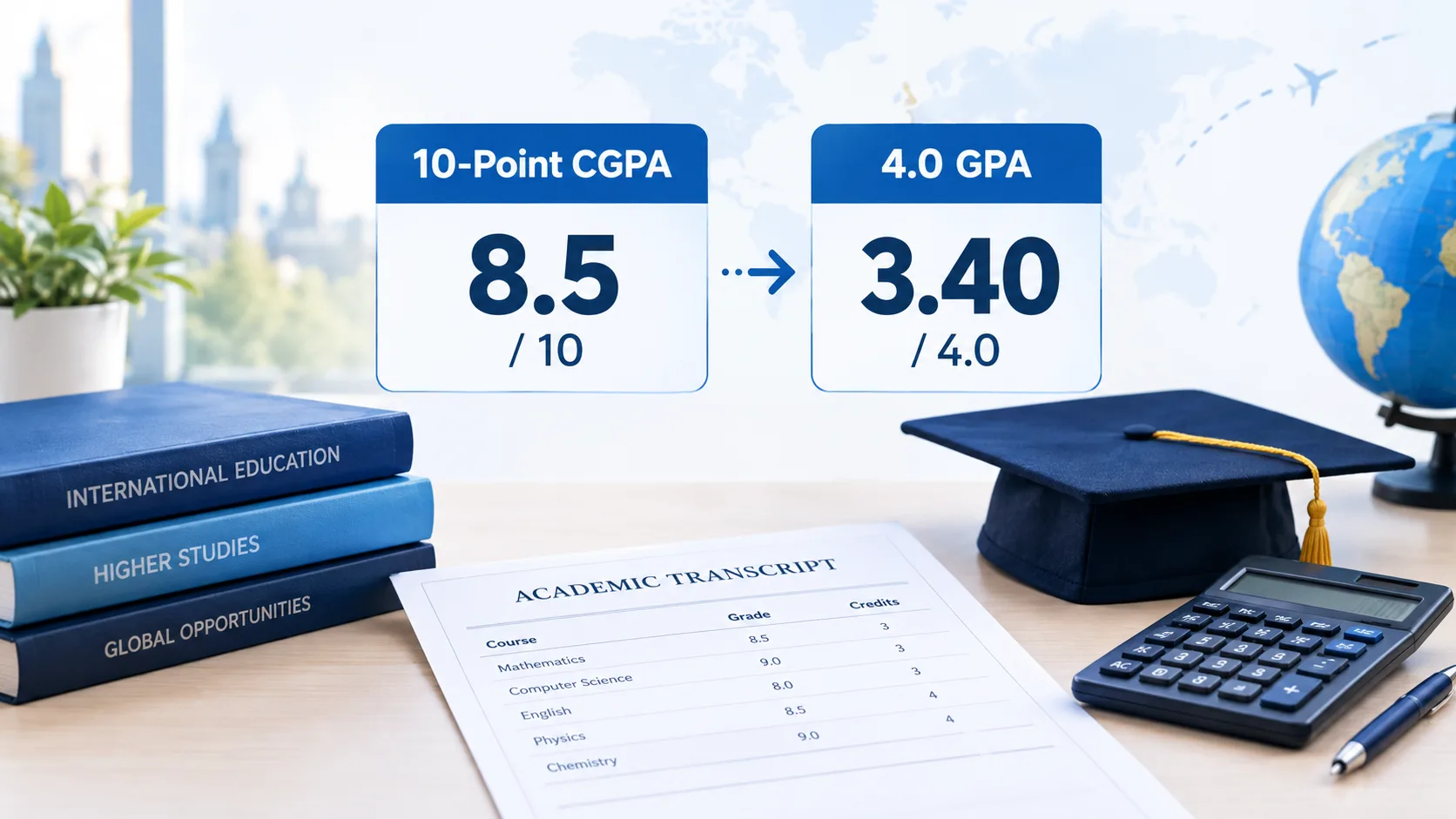
If you’re applying to a university abroad with a 10-point CGPA, you may wonder how it compares with the 4.0 GPA scale used by some institutions in the United States and Canada.
For example, using a simple linear formula, an 8.5 CGPA out of 10 gives an estimated 3.4 out of 4.0. However, this is a mathematical estimate, not necessarily the GPA a university or credential evaluation agency would assign.
This guide explains the formula, provides conversion examples, highlights common mistakes to avoid when submitting university applications, and explores how credential evaluations and university requirements can affect the way you report your grades.
Quick Answer: How Do You Convert 10 Point CGPA to 4.0 GPA?
For a quick estimate, you can use:
Estimated GPA = (CGPA ÷ 10) × 4
For example, if your CGPA is 8.5 out of 10:
(8.5 ÷ 10) × 4 = 3.40
So, 8.5 CGPA gives an estimated GPA of 3.40 on a 4.0 scale.
This calculation is useful for an initial comparison, but it is a mathematical estimate, not necessarily an official GPA equivalency.
What Is CGPA?
CGPA (Cumulative Grade Point Average) represents your overall academic performance across multiple semesters or years of study. Many institutions use a 10-point CGPA system, although grading rules can vary by university.
You may also come across these related terms:
- SGPA: Your grade point average for a particular semester.
- CGPA: Your cumulative grade point average across your program.
- Cumulative Percentage: A percentage-based measure that some institutions use alongside or instead of CGPA.
Your university may also provide an official conversion formula on your transcript or academic documents. If it does, check that information before using a general conversion formula.
What Is a 4.0 GPA scale?
A 4.0 GPA scale is widely used in U.S. higher education and is also used by some institutions and programs elsewhere. Under a typical 4.0 system, letter grades are assigned corresponding grade points.
A simplified example is:
| Letter Grade | Grade Point |
| A | 4.0 |
| B | 3.0 |
| C | 2.0 |
| D | 1.0 |
| F | 0.0 |
The exact grading scale can vary by institution. This is one reason international grade conversion requires care.
For a broader explanation of how GPA and CGPA differ, see our guide on CGPA vs GPA.
10-Point CGPA to 4.0 GPA Conversion Table
The following table uses the same linear formula:
Estimated GPA = (CGPA ÷ 10) × 4Important: The values are mathematical estimates based only on that formula. They should not be interpreted as official university or credential-evaluation equivalents.
| 10-Point CGPA | Estimated 4.0 GPA |
| 10.0 | 4.00 |
| 9.5 | 3.80 |
| 9.0 | 3.60 |
| 8.5 | 3.40 |
| 8.0 | 3.20 |
| 7.5 | 3.00 |
| 7.0 | 2.80 |
| 6.5 | 2.60 |
| 6.0 | 2.40 |
| 5.5 | 2.20 |
| 5.0 | 2.00 |
| 4.5 | 1.80 |
| 4.0 | 1.60 |
| 3.5 | 1.40 |
| 3.0 | 1.20 |
| 2.5 | 1.00 |
| 2.0 | 0.80 |
| 1.5 | 0.60 |
| 1.0 | 0.40 |
| 0.5 | 0.20 |
| 0.0 | 0.0 |
If your CGPA falls between the values shown, you can apply the same formula to your exact number.
How to Convert Your CGPA to a 4.0 GPA Scale
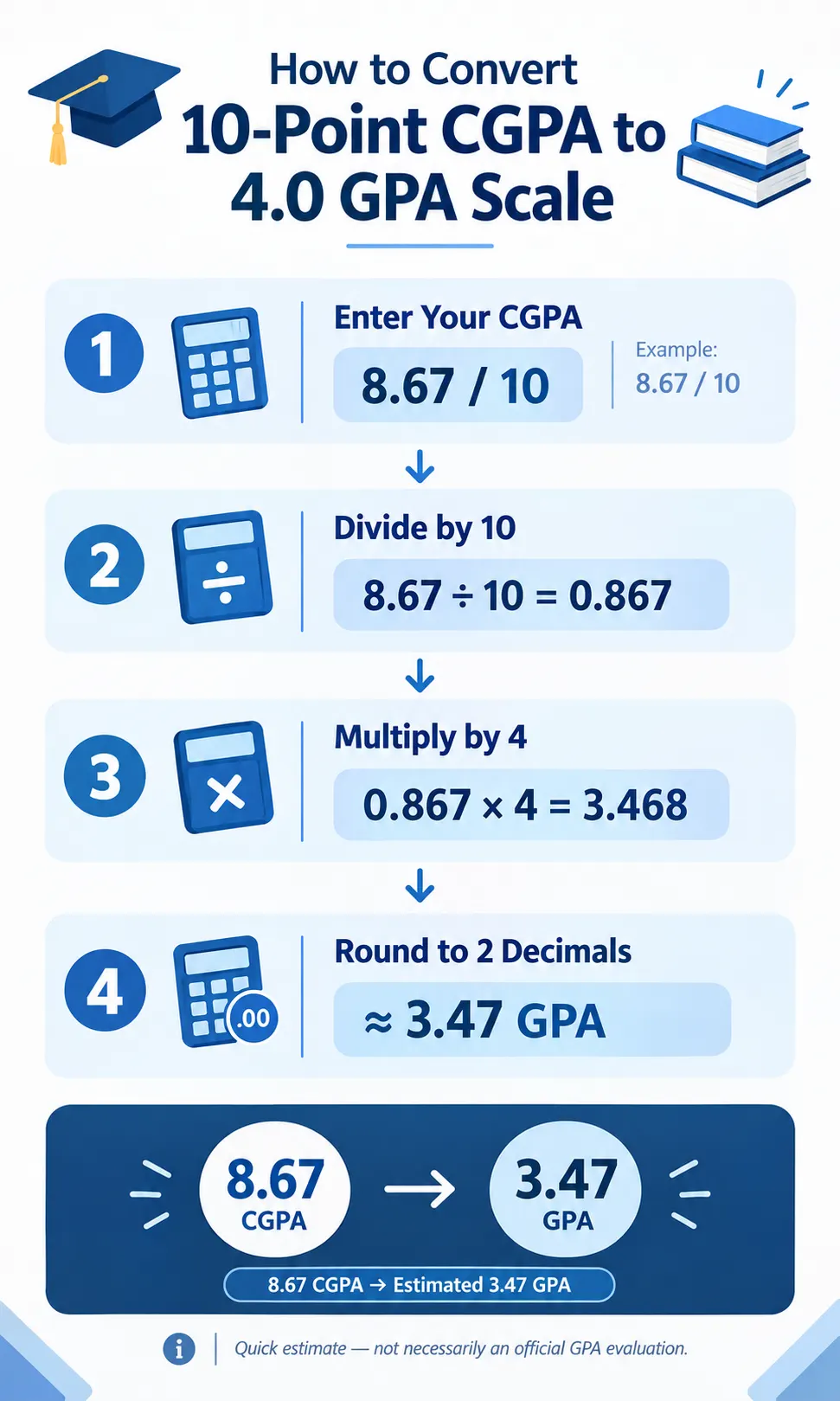
If you want to calculate an estimated GPA yourself, apply the formula to your CGPA.
Let’s use a CGPA of 8.67 as an example.
First, divide your CGPA by 10:
8.67 ÷ 10 = 0.867
Next, multiply the result by 4:
0.867 × 4 = 3.468
Finally, round the number to two decimal places:
3.468 ≈ 3.47 GPA
Based on this mathematical calculation, 8.67 CGPA gives an estimated 3.47 GPA on a 4.0 scale.
For an explanation of why this number may differ from an evaluated GPA, see Why Isn’t CGPA-to-GPA Conversion Always Straightforward?
Why Isn’t CGPA-to-GPA Conversion Always Straightforward?
The formula above treats the conversion as a simple proportional relationship between two scales. That can be useful for a quick comparison, but international academic records can contain much more information than a single cumulative number.
Different Institutional Grading Systems
A 10-point CGPA does not necessarily represent the same grading structure at every university.
Institutions can use different:
- Grade boundaries
- Grade-point assignments
- Percentage ranges
- Letter-grade systems
- Methods for calculating cumulative results
For example, two universities may both report a maximum CGPA of 10, while using different rules to determine how individual marks become grade points.
This means that the number 8.5 cannot automatically be assumed to have exactly the same academic meaning across every institution.
Individual Course Grades Matter
A final CGPA summarizes academic performance, but an academic record can contain the grades earned in individual subjects.
Two students could both have an 8.5 CGPA, while they can have different distributions of grades across their courses. When an institution or evaluation provider reviews a transcript, the underlying academic record may therefore provide information that a simple CGPA-to-GPA formula does not capture.
Credit Hours Can Affect Calculations
Courses do not always carry the same number of credits.
For example, a four-credit course and a one-credit course may have different effects on a credit-weighted GPA calculation. A simple conversion based only on the final CGPA does not examine how individual course results were distributed across credit values.
This is one reason a self-calculated 4.0-scale estimate can differ from a calculation based on course-level academic records.
Institutional Conversion Policies Differ
Some universities provide their own instructions for interpreting international grades. Others may ask applicants to provide their original grades rather than converting them themselves.
A university may also specify whether applicants should provide:
- The original CGPA
- A percentage
- A GPA on a particular scale
- A credential evaluation
- Another form of academic information
When specific instructions exist, those instructions take priority over a general mathematical formula.
Credential Evaluations Can Use More Than the Final CGPA
A credential evaluation is different from simply multiplying a CGPA by 0.4.
Depending on the evaluation and the information available, an evaluator may need to consider the institution, grading system, individual courses, credits, and other transcript information.
As a result, two students with the same overall CGPA may potentially receive different evaluated results if their underlying academic records or institutional grading systems differ.
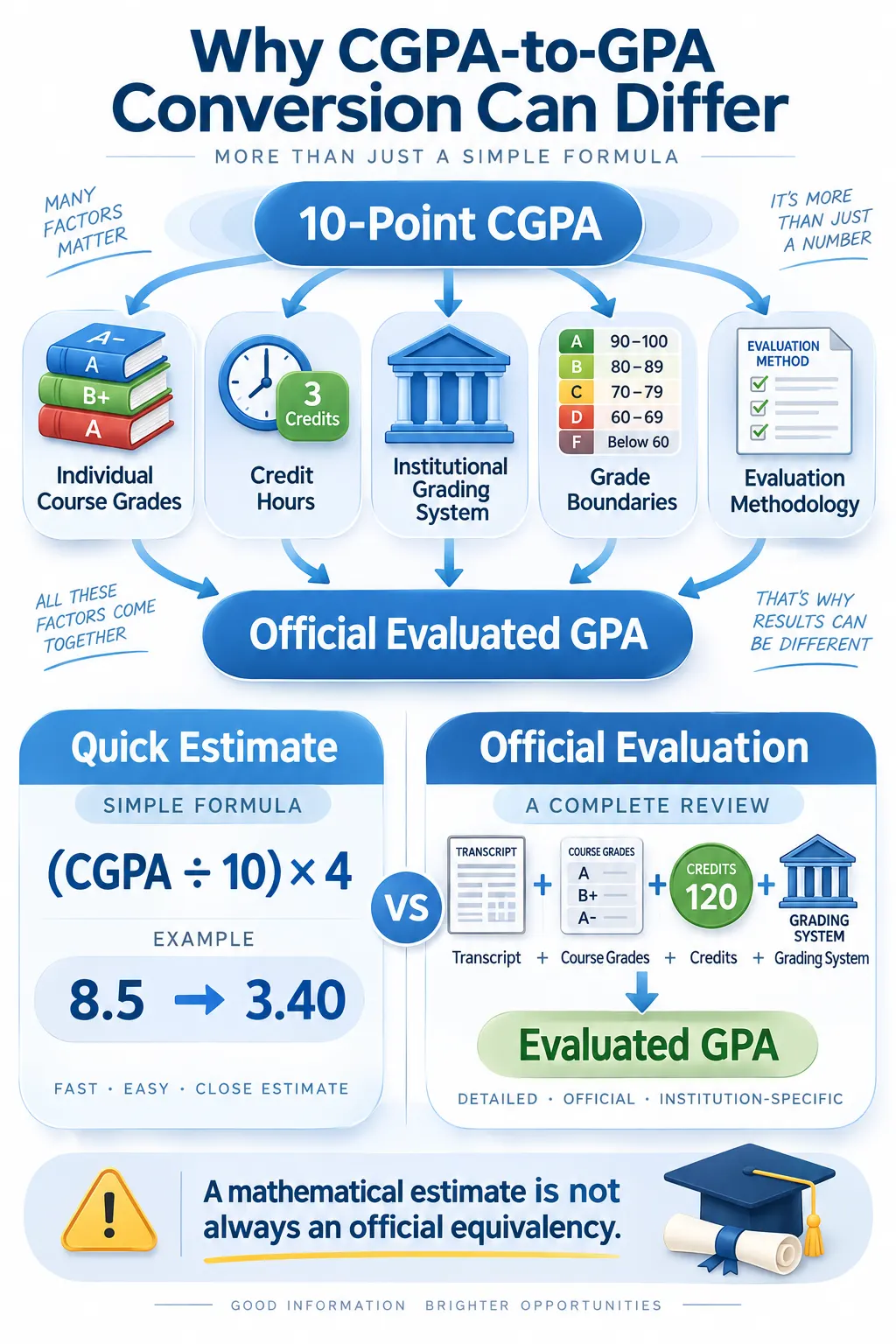
The linear formula answers a mathematical conversion question. An official evaluation may involve interpretation of the underlying academic record.
How Does WES Evaluate a 10-Point CGPA?
What Is WES?
World Education Services (WES) is a credential evaluation organization that evaluates academic credentials earned outside the U.S. and Canada. Its evaluations help universities, employers, licensing bodies, and other organizations understand international academic credentials.
Students may be asked to obtain a WES evaluation for certain university applications, professional programs, licensing processes, employment purposes, or other situations.
WES offers different types of credential evaluation reports, including Document-by-Document (DxD) and Course-by-Course (CxC) evaluations. The type you need depends on the requirements of the university or organization receiving your application.
Does WES Use the Simple CGPA-to-GPA Formula?
You should not assume that WES calculates your GPA by simply applying the following formula:
(CGPA ÷ 10) × 4WES offers a Course-by-Course evaluation that provides individual course information, U.S. or Canadian credit and grade equivalents, and a calculated GPA on a 4.0 scale. This is different from simply multiplying your overall CGPA by 0.4.
WES also provides a GPA Calculator that allows users to estimate how their grades compare with a U.S. 4.0 scale using common grading scales for their country of education. This tool is distinct from an official credential evaluation.
What Information Does a WES Course-by-Course Evaluation Provide?
According to WES’s official description of its Course-by-Course evaluation, the report includes a detailed analysis of post-secondary coursework, along with converted credit and grade information and a GPA on a 4.0 scale.
The report can include:
- Individual courses: A list of completed post-secondary courses included in the evaluation.
- Grade equivalents: U.S. or Canadian grade equivalents for individual courses.
- Credit equivalents: U.S. or Canadian semester credit equivalents for courses.
- GPA: A calculated GPA on a 4.0 scale for the applicable evaluation.
These are the publicly documented features of the report. They describe the information WES provides without attempting to reproduce its complete assessment methodology or predict an individual student’s evaluation result.
Document-by-Document vs. Course-by-Course Evaluation
WES provides different report types for different purposes.
| Feature | Document-by-Document | Course-by-Course |
| Credential identification | Yes | Yes |
| U.S. or Canadian credential equivalency | Yes | Yes |
| Individual course breakdown | No | Yes |
| Individual course grade equivalents | No | Yes |
| Semester credit equivalents | No | Yes |
| GPA on a 4.0 scale | Not included | Included |
If you are applying to a university, check which report type it requires before submitting a WES application. You can also review WES’s explanation of the two evaluation types.
Illustrative Example: Two Students With the Same CGPA
Consider two students who both have an 8.0 CGPA on a 10-point scale.
| Student | CGPA | Simple Mathematical Estimate |
| Student A | 8.0 | 3.20 |
| Student B | 8.0 | 3.20 |
Using the linear formula, both students receive the same mathematical estimate of 3.20. However, their transcripts may contain different course grades, credits, or other academic details. A Course-by-Course evaluation provides information about these individual courses rather than only the overall CGPA.
This example is illustrative. It does not mean that WES will necessarily assign different GPAs to students with the same CGPA. Their actual results depend on the assessment of their submitted academic credentials.
What Should You Do If Your University Requires WES?
If your university specifically requires a WES evaluation, follow its instructions regarding the report type, documents, and submission process.
Use the GPA stated in your WES report when the university asks for the evaluated GPA. Do not substitute a self-calculated estimate unless the university explicitly permits it.
For more information, visit the official WES Credential Evaluations page or its guide to understanding a WES evaluation report.
Key Takeaway: The formula
(CGPA ÷ 10) × 4provides a simple mathematical estimate, while a WES Course-by-Course evaluation provides a documented assessment of individual courses, grade and credit equivalents, and a GPA. If a university requires an official WES evaluation, follow its requirements and use the resulting report.
After estimating or officially evaluating your GPA, you may also want to understand admission-related GPA information. See our guide on GPA Requirements for Top U.S. Universities.
Which GPA Should You Report on a University Application?
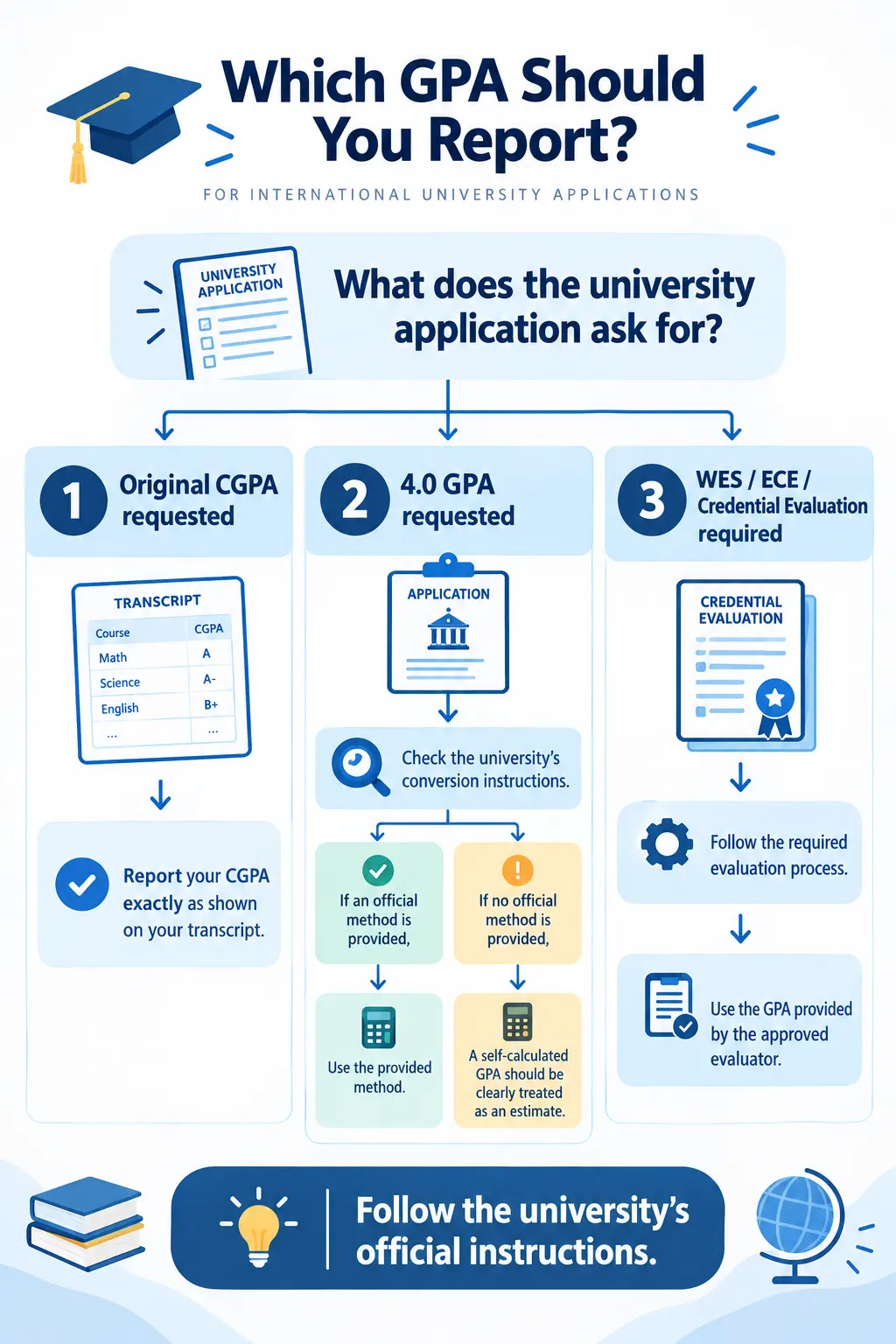
This is where many students get confused. The answer depends on what the application actually asks for.
1. If the application asks for your original CGPA
Enter your CGPA exactly as it appears on your transcript.
For example, if your transcript reports:
CGPA: 8.4 / 10
and the application asks for your original cumulative grade, report 8.4/10 rather than replacing it with a self-calculated 3.36.
2. If the University Provides Its Own Conversion Instructions
Follow the university’s instructions.
If the application or admissions website gives you a specific method for converting international grades, use that method rather than choosing a general formula yourself.
Keep a record of the method you used in case the application asks you to explain the calculation.
3. If the University Requires a Credential Evaluation
Use the credential evaluation provider specified by the university.
For example, if the application specifically requires an evaluation from WES, ECE, or another named provider, follow those requirements rather than substituting a self-calculated GPA.
Check whether the university requires the evaluator to send the report directly or whether you need to upload it yourself.
4. If the Application Asks for a 4.0 GPA but Gives No Conversion Instructions
First check the university’s admissions website, application instructions, and international applicant guidance.
If the instructions still do not explain how to enter an international CGPA, do not assume that a self-calculated GPA is automatically accepted.
You can contact the admissions office and ask whether you should:
- Enter your original CGPA
- Convert it to a 4.0 scale
- Leave the field blank or select an international grading option
- Provide a credential evaluation
If the university confirms that a self-calculated conversion is acceptable, use the method it provides or the method it explicitly recommends.
Common Mistakes When Converting CGPA to GPA
Converting a 10-point CGPA to a 4.0 GPA may seem straightforward, but many students make mistakes that can lead to confusion during the application process. Here are some of the most common ones to avoid.
1. Treating a Mathematical Estimate as an Official GPA
What to avoid: Presenting a number calculated with the linear formula as though a university or evaluation agency officially issued it.
How to prevent it: Clearly distinguish between a self-calculated estimate and an official evaluation when completing applications or documents.
2. Using the Wrong Maximum CGPA Scale
What to avoid: Applying the 10-point formula to a CGPA that comes from a 4.0, 5.0, or another grading scale.
How to prevent it: Check your transcript or university documentation to confirm the maximum scale before calculating.
3. Applying a Formula Without Checking the Instructions
What to avoid: Automatically using (CGPA ÷ 10) × 4 when the university has provided a different method.
How to prevent it: Check the application instructions and your university’s academic documents first.
4. Confusing a Credential Evaluation With a Self-Calculation
What to avoid: Treating your own calculation as equivalent to a report prepared by a credential evaluation provider.
How to prevent it: If an official evaluation is required, obtain and submit the evaluation specified by the receiving institution.
5. Reporting a Converted GPA When the Application Asks for the Original Transcript Value
What to avoid: Replacing your original CGPA with a converted 4.0-scale number when the application specifically asks for the value shown on your transcript.
How to prevent it: Read the field label carefully and enter the academic information in the format requested.
6. Rounding or Adjusting a GPA to Look Higher
What to avoid: Changing a calculated result to make it appear more competitive. For example, if your calculation produces 3.47, do not report it as 3.7.
How to prevent it: Use the actual value produced by the permitted calculation method and follow any rounding instructions provided by the university.
Final Takeaway
A 10-point CGPA can be converted to a 4.0 scale mathematically for an initial comparison, but the number you calculate yourself may not be the number used for an official academic evaluation.
When applying to a university, use the grading information and conversion method specified by that institution. If the requirements are unclear, confirm with the admissions office before submitting a self-calculated GPA.
Frequently Asked Questions (FAQs)
Is 8.5 CGPA equivalent to 3.4 GPA?
Using the linear formula in this article, 8.5 CGPA converts to an estimated 3.40 GPA on a 4.0 scale.
For an application, however, check whether the university accepts this type of self-calculated conversion.
How do I convert a 10-point CGPA to a 4.0 GPA?
A simple way is to divide your CGPA by 10 and then multiply the result by 4. For example, a student with an 8.5 CGPA would have an estimated GPA of 3.4. This method provides a quick comparison with the U.S. grading system, but it may not match an official evaluation.
Can two students with the same CGPA receive different GPA evaluations?
Yes. Two students can have the same CGPA but receive different GPA evaluations. This can happen because evaluators may consider course credits, subject-level performance, grading systems, and transcript details rather than relying solely on the final CGPA.
Which GPA should I report on university applications?
Always follow the instructions provided by the university. If the application asks for your original CGPA, report it exactly as it appears on your transcript. If the university provides a conversion method, use that method. If a credential evaluation from WES or another approved provider is required, report the GPA from the official evaluation rather than a self-calculated estimate.
Do I need WES to convert my CGPA to a 4.0 GPA?
Not necessarily. A WES evaluation is only needed when the university or other organization receiving your application requires it. If no evaluation is required, check the institution’s instructions for how it wants international grades reported.
What if a university does not explain how to convert my CGPA?
Check its international applicant and admissions instructions first. If the required format is still unclear, contact the admissions office and ask whether it wants your original CGPA, a self-calculated 4.0 GPA, or an official credential evaluation.
